Saturday, 2 February 2019

January water-bird counts


     A couple of days ago we finally felt that we had enough spare diesel to be able to do the January African Waterfowl Census water bird counts at Shumba, Masuma and Mandavu. We do these counts every January and July and submit the data to Birdlife Zimbabwe who send it on to Wetlands International, the co-ordinators of International Waterbird Counts since 1967.
   Sue and I have been involved in various bird data projects over many years and birds are part of our daily lives at Sinamatella. There are several species and individuals of birds that have become very tame and treat us as part of the scenery  - albeit an unusual part of the scenery  that can be relied upon to supply breadcrumbs and other food, more or less on demand. We have Red-headed weavers nesting on the veranda above our dining table which van be messy - but interesting. In the dry season I share my breakfast most mornings with Barbie the Crested Barbet and her companion who we have inevitably named Ken. Throughout the year the local group of White-browed sparrow-weavers who nest close to our house in a big Mopane tree, forage on and around our veranda (especially at meal times) and recently a pair of Red-billed Hornbills has developed the same habit. They first started getting tame during the hungry time around end of last dry season and were here looking for food when the first rain fell - giving Sue an opportunity for a memorable photograph.......

    We have an artificial nest box in the Mopane tree which has been used in the past by Grey-headed sparrows and by squirrels but this year the hornbills decided they would use it. Either they breed in very cramped nest-holes or they have misjudged the size of the box; either way, we thought they should  be offered a bigger alternative so one day Sue and I made a new, larger box. The hornbills watched from just a few metres away as I climbed a ladder and fixed the new box in the tree. I was sure they would be afraid of it but by the time I had removed the ladder and sat down to watch, they were already investigating and carrying dummy pieces of nest material which they passed from beak to beak then dropped on the ground. 


     Two weeks later that is what they still do every morning and evening and there is no sign that they intend to go any further. We'll see what happens.
   Meanwhile, back to the waterfowl census.....
   We travelled first to Shumba where we count at Elephant Pan, Dwarf Goose Pan, Reedbuck Vlei, Big Shumba, Shumba Pan and Camp Hwange Pan. Rainfall has been below average and very patchy so far this season but even so we were surprised to find that of those seven sites, only the two pumped pans, Shumba and Camp Hwange, had any water. Consequently the count was low and we saw more interesting birds in the grasslands than we did at the pans. There were a few Grey crowned cranes stripping seeds from the grass flowers.....

And Carmine and Blue-cheeked bee-eaters in the more open patches, though the Blue-cheeked were camera shy so Sue only managed to photograph the Carmine........

As well as birds, the Shumba grasslands usually have something else interesting to offer. We met up with a Black-backed jackal which trotted along in front of us for a while but wouldn't stay still for a photo. These two Steenbok were more accommodating......

   But we eventually left Shumba and headed to Masuma, with a rather disappointing bird count up to that point. Masuma though, was unusually good. The dam itself had quite a few water birds such as these two Egyptian geese....

In view of the crocodile that you can see sliding towards them, the one running away on the left looks the more sensible to me!
Away from the actual dam we had some of the best birding of the day at a number of small, flooded pans. A Wood sandpiper absolutely refused to be intimidated by the Land Rover parked right next to it so even I was able to get a photo......

  And my favourite sighting of the day was this Dwarf bittern.....

 At the other end of the size scale, one of the little pans was occupied by a thirsty elephant......

The difference in amount of water between the Shumba and Masuma areas was quite startling considering they are only about 14km apart but it shows the patchiness of this year's rainfall. Mandavu, our next stop, has had relatively good rain and holds plenty of water as well as plenty of birds. We counted 437 water birds of 32 species. Mandavu is big and it takes a couple of hours to scan the whole shoreline (from seven or eight separate points) so by the end of it we were more than ready to head for home and put the kettle on. By this stage, anyone reading this blog post probably feels much the same so I'll leave any write-up of Mandavu's birds for another day!


Tuesday, 22 January 2019

Veld reclamation


     These are worrying times for Zimbabwe. Last week, Bulawayo,  Harare and elsewhere were in turmoil with protests over the economic situation in the Country, but at Sinamatella we were cut off from the rest of the world by the government's shutdown of the internet combined with a two-day power failure. This is not meant to be a political or current affairs blog so I won't comment further on the events of the week away from Sinamatella except to hope that there will be a happy ending to this very long-running story. What that happy ending might be is anybody's guess but let's hope that it is better than the one we thought we had reached in November 2017 - which turns out to have been neither happy, nor the end.
   So, the week at Sinamatella. Over the years that we have lived here we have noticed (we think) a steady increase in the amount of bare, eroded ground we can see as we look out over the park from the top of the hill.  Rainwater rushing over the surface has caused sheet erosion which continues every rainy season........

And the depth of the soil loss is shown by the exposed roots on this old Mopane stump.....

    We have no measurements to show that the bare areas are increasing but even if they are not, they are still a worry. We put a lot of effort into providing water for the animals but that is of no value if they don't also have food. This isn't a new idea - the Parks Authority staff worked on veld reclamation right into the 90's but nothing has been done since then so we decided that this should be the year that we start again, trying to do something about the situation.
   Towards the end of last year, the Hwange Conservation Society (UK) very kindly agreed to fund an experimental piece of veld reclamation that we can replicate on a larger scale if it is a success. We chose a piece of land close to Sinamatella that has been heavily affected by sheet erosion but is easily accessible for the necessary work and for monitoring afterwards. Most of it looks like this.....


But our aim is to get it looking like this piece of land, only a couple of hundred meters away.........

   I know, from speaking to some of the people involved in reclamation in the past, that they relied mainly on laying down brush lines (that's lines of cut bush that provide shade and protection from grazers for delicate grass seedlings). Professor Google and good old-fashioned books I've looked at suggest that breaking up the soil crust is also important and we know that works from having seen the effect of laying pipelines under bare ground for game water - the disturbed soil quickly becomes well covered with vegetation. So, we decided to try out a variety of methods....1. brush lines alone, 2. breaking up the soil in lines with a ripper then covering with brush and 3. breaking the soil but not laying brush lines. And so, to work.
    First, cutting brush. It would be a bit counter-productive to destroy useful vegetation in an experiment on encouraging vegetation so we cut the brush where it isn't wanted - along the edges of the Sinamatella airstrip. The airstrip isn't much used. The last time a plane landed was in September 2017 so the strip......

And the airport buildings (departure lounge, customs and immigration, duty-free shop - that sort of thing )........

....... are a bit neglected.
 We loaded the cut brush into our old Land Cruiser (affectionately known as 'Granny')........


While the tractor was doing the heavy work, ripping the soil at the experimental plot......

Then we laid out the brush lines....

.....and thought we had finished.
   It all looked very neat and we were rather proud of it. I suppose that was the mistake because a couple of hours later a heavy storm with very strong winds swept across the whole thing and scattered our neat brush lines as if they were made of paper. That's what experimenting is about of course - you learn by testing out ideas and clearly, unsupported brush lines are an idea that doesn't work. Faced with either having to add a lot more brush to make it all much heavier or pegging the lines down with rough stakes, we decided on the stakes and that has now been done.  From here we have to monitor the success or otherwise of the various plans and then decide if we want to scale the programme up before next rainy season. No doubt I'll have more to say on this in the next few months.

Sunday, 13 January 2019

Mandavu Dam Wall


     If I had made any New Year's resolutions (I didn't) I might well have resolved to post to this blog on a regular basis and I would already be close to breaking my resolution. That's entirely normal of course but... I would have an excuse (and a real one at that!) For some time after we got back from our Christmas break, we were without a reliable internet connection. Eventually we discovered that the problem was not some arcane bit of IT or satellite programming that had gone wrong but something we could solve fairly easily - the mounting for the satellite dish was coming away from the wall and putting the dish out of alignment. I fixed it back up and it seems to be OK now, so here goes......

   Mandavu Dam.
    Fourteen kilometers from Sinamatella is the biggest body of open water in Hwange National Park - Mandavu Dam. It's a hugely productive dam, thanks to the nutrients introduced by the hippos and the hundreds of buffalo, elephants and others that drink there in the dry season so it is popular with anglers who are allowed to fish there at weekends. It's also a vital part of Sinamatella's game water supplies, and an important breeding and feeding place for numerous birds.


 We pass the dam regularly and often spend time there counting and listing birds but until recently we had never given a thought to the maintenance of the actual dam wall. I'm certain we wouldn't have thought of it now if Colin Gillies from Wildlife and Environment Zimbabwe hadn't e-mailed me with some concerns over the state of the wall. I knew about as much about dam wall maintenance as I do about computers (i.e. next to nothing) so I asked my good friend Professor Google for help. He, of course, knows more or less everything, and as I read through various websites that he suggested, I became more and more concerned.
   The first thing I was sure we needed to worry about was trees. Apparently, trees on an earth dam are a disaster waiting to happen. Mandavu didn't have trees - it had a forest........


   The road across the wall - dam to the left, forest to the right!
   Next concern was termites and animal burrows. We have both of those all over Sinamatella so probably at Mandavu too but had anyone ever checked? Almost certainly not.
  Prof Google guided me to one website that gave a series of stages to look for to show any deterioration in a dam wall. First stage, in which there is nothing to worry about,  is a flow of clear water on the downstream side and the final stage, probably best labelled 'panic',  is a whirlpool in the dam itself and a strong flow of muddy water and debris downstream. As far as I could see, at that stage all you can do is 1. Run for your life and 2. Call the emergency services. I was pretty sure that we were far from that situation but not at all sure of anything else so Courage Mutema, the Sinamatella Parks Ecologist and myself went out to have a look.
   It was, as you would expect, a mixture of good news and bad news. The good news was that there was a small flow of clear water through the wall, there were no active termite nests (though there were some large ant nests) and no obvious animal burrows. The bad news items were that the wall was covered in trees, that many of the rocks which are meant to resist wave action (the technical term seems to be rip-rap) were out of place and that the road across the wall has eroded, causing rain water to pour down the back face of the wall where it has cut some fairly disturbing gullies.


Part of one of the gullies - not something you want to see in a dam wall!
   The gullies were obviously something we should be dealing with very soon so we started work on them first. A proper solution to the problem will mean rebuilding the top of the wall to direct rainwater into the rip-rap but that will take some organising. For now, we have simply thrown tons of rock and brush into the deepest gullies and we'll try to cover them over with soil so that grass can grow and bind it all together. It would have been nice to have heavy earthmoving equipment to do this but that's way beyond our resources. Instead, we have manpower, and of course a Land Rover ....


   Removing the trees turned out to be a huge task. If they had been Mopane, as they would have been in most parts of Sinamatella, it would have been difficult enough but in fact they were mostly Acacia tortilis, which comes armed with both hooked and straight thorns..........


   ..........and strongly objects to being handled. It took us two full days to fell all the trees, cut them into reasonably sized pieces, winch them up to the top of the wall and stack them. By the end we were all heavily scratched and thoroughly fed up with the task but satisfied to have got it done. I will go and kill all the tree stumps with a strong alkali to stop re-growth and poison the ants whose nests seem to go deep into the wall. We will eventually re-build the eroded crest of the wall and spread the branches over it to protect the loose soil and encourage grass-growth. All being well, this is a lesson learnt and regular dam maintenance will become part of the annual work schedule at Sinamatella. We are grateful to Colin Gillies for pointing out what needed to be done - but I have to say, there were times as I pulled yet more hooked thorns out of my skin, when I wasn't quite so grateful!

Tuesday, 11 December 2018

November 2018


  I haven't posted anything to this blog for a few years. That wasn't through laziness or lack of interest but simply because our computer became so out of date it was no longer able to add photos to the text - and without the photos I don't think there would be many people interested
   The possibility of re-opening the blog has arisen several times recently and eventually I thought I would give it a go - and my test-post worked so here goes........
   Bhejane Trust puts out a regular newsletter. It was, for a long time, a monthly effort but from the end of October 2018 it became bi-monthly. That means there was no newsletter  for November so this post will be a summary of what I would probably have written.
   I usually start with news on game water supplies. Normally by mid-November we can begin to relax because rain falls far out in the Park, the elephants (who are our main customers) leave and the water levels of our main pans and dams begin to recover. This year the rains were late arriving and November was very hot and very dry so we were under more pressure than we would have expected (or wanted). Our most important site (in that it attracts the most animals and the most tourists) is Masuma Dam. By the 10th November the level of the dam was way down on normal.....

  A reading of the meter at the solar/diesel pump that supplies the dam showed that we were pumping 86,000 litres per day. That sounds like a lot but when you  consider that there were over a thousand elephants drinking there each day as well as hundreds of buffalo, kudu, impala and others, it's clear that 86,000 litres is not enough.

                                          Elephants crowded around the trough at Masuma  
The weather forecast suggested we could expect rain soon so we decided not to panic, to keep the solar/diesel pump running and hope for nature to solve the problem.  However, a week or so later we realised that wasn't going to happen so we replaced the pump with one that runs purely on diesel and supplies a lot more water per hour. Camp Hwange, Kashawe Camp, Kapula Camp and Bumbusi Camp all chipped in with donations of diesel and for the first time in several weeks we were able to put more water into Masuma than the animals were taking out. The level of the dam rose and all was well but it was a close-run thing.
   Meanwhile, this happened at Shumba.........

                                         
  At first we blamed the elephants - after all, it wouldn't be the first time they have done something like this! Closer inspection though, suggested the damage had been done by strong winds. Either way, it put the pump out of action at a crucial time. It took us one day to travel out to Shumba, dismantle the mess and bring it back to Sinamatella, the next day to make a new frame from bits of the old one and a third day to get it all re-assembled. Many thanks to Antoinette van Wijk and Peter Mc Sporran-Edwards, who were with us at the time and put a lot of effort into helping to get this pump back in action. It was hard work, but very satisfying.
    I'm glad to say there were no other major breakdowns to contend with. Even so the situation at some of our water points was pretty hectic, with elephants drinking in large numbers throughout the day and most of the night.  Hard though it is, we have to accept that at some point it will become impossible to cope with the ever-increasing number of elephants in the Park and this November showed us how close we might be to that point. We will have to give that some careful thought during the coming rainy season.
  Wildlife
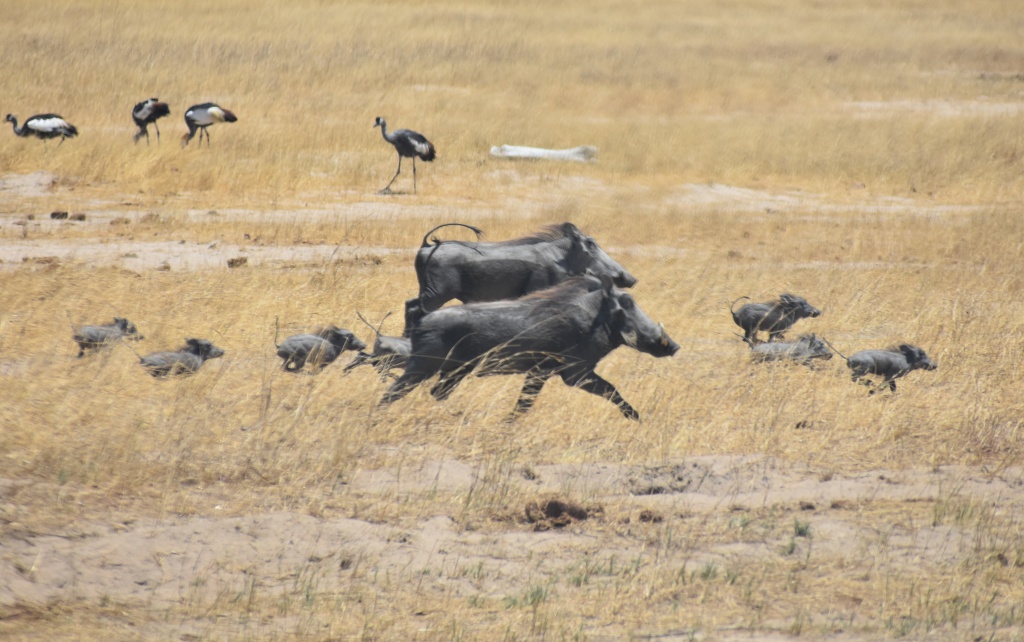
      Out in the Park, November was a great time for animal viewing - provided you didn't think too deeply about how tough the animals must have been finding their lives in the absence of decent rain. I felt sorriest for the females with babies. Every year, Sue tries to get decent photos of the baby impala with their long legs and Disney-cartoon faces and the baby warthogs - impossibly cute for such a bizarre-looking animal. As usual, this year neither species co-operated, running away long before Sue could get the camera lined up and these are the best she got (and I know she will be annoyed with me for using these pictures - they are not up to her preferred standard!).......

  
 Not all the young animals survived of course.

  It appeared that this little zebra was killed by a lion but abandoned in favour of the young elephant that was killed nearby by other members of the pride and is just visible in this picture, surrounded by vultures.

   Similar tragedies must have occurred in many other places - though of course they are not tragedies from the point of view of the predators and scavengers.
   At home in Sinamatella Camp, we were very much aware of the difficulties facing the animals as many of them came to forage in and around our house and to beg from us at meal times. It made for some easy photo-opportunities.......


 It's nice having all these animals around but of course it would be better if the rain would come and they could find plentiful natural food. It isn't far away .........