Wednesday, 18 September 2013

Hooded Vultures

    Around this time last year lions were becoming a regular feature of the Masuma Dam area as they preyed on elephants coming in to drink. We were at Masuma recently to carry out a mammal count and we heard that the lions were not far away so Sue drove down to get some photos.
     She found that an elephant had died of natural causes and the lions, never very fussy feeders, were getting a free meal. There were several females….

With cubs………


Two adult males…..


And a young male…….


With a whole elephant to deal with there was food to spare so there were plenty of vultures……..


And a jackal waiting for a chance to get at the carcase……..


Back at the dam, I was enjoying watching a fairly newly born hippo trying (without success) to bother its mother into taking some notice of it…..


It stayed close to its her and she was very protective, chasing any other hippo that came close….


Later in the day a Hooded Vulture came in for a drink……


It was soon joined by a second vulture and they spent a long time together next to the water. They sunbathed…..


They stood together and posed for the camera….


They twined necks and rubbed heads…..


And Sue became convinced they were more than just good friends. Boring old me, trying to be scientific, said we shouldn’t anthropomorphise but as it turned out, Sue was probably right…….


So there should be a Hooded Vulture nest somewhere by now but strangely, although we see many of that species, as well as White-headed, Lappet-faced and White-backed vultures, we’ve only ever seen White-backed nesting in the Park.  No doubt the other species do so but I don’t know where.


Wednesday, 4 September 2013

"Museuming"

It’s a long time since I posted anything to this blog. As well as a long period when we had no internet access, we’ve also been busy with two groups of very helpful French volunteers and have just spent a week in Bulawayo so I haven’t had much chance to write anything.
    One of the projects we have been involved with is what we are calling ‘museuming’. This started from the Southern Africa Bird Atlas Project that seeks to collect presence/absence data for bird species in approximately 9km x 9km map squares called Pentads. Why not, we thought, do the same thing but for some of the more overlooked species in the Park and get photos of them as well since, in many cases we would not be able to identify them down to species level. It seemed a good idea so one day when we had been at Chawato for a mammal count, we made a start by spending some time turning over rocks to look for insects, spiders, scorpions, lizards or whatever else was to be seen. That might not sound like a lot of fun but we, and especially Sue, have been absolutely gripped by the whole thing and we find ourselves looking for new specimens wherever we go. Sue has been collecting all the photos and details of where they were found etc into our Sinamatella virtual museum – effectively the beginning of an inventory project for the area. It is obviously a massive task and we know we will get nowhere near a complete inventory but anything we get is more than we have at the moment and at a time of rapid environmental change it is potentially valuable (as well as fun!)
   At this time of year there are few insects to be seen but even so, insects and arachnids have made up most of the specimens so far.  Some of the small creatures are quite spectacular when they are photographed close to. This is a jumping spider, family Salticidae

It’s only about 7 mm long but must be a formidable sight to its prey.
Another spectacular-looking spider is this Wolf Spider (Lycosid) which Sue found at the entrance to its nest under a rock near Baobab Pan.                .
It’s a strange creature at normal magnification but its ‘face’, enlarged, is frankly weird.

Along with the spiders, we’ve found quite a few scorpions. The nastiest looking, like this big Rock Scorpion  are supposedly the least dangerous and certainly this one made no attempt to do anything aggressive when we found it at the Gurangwenya River while we were setting a camera trap.


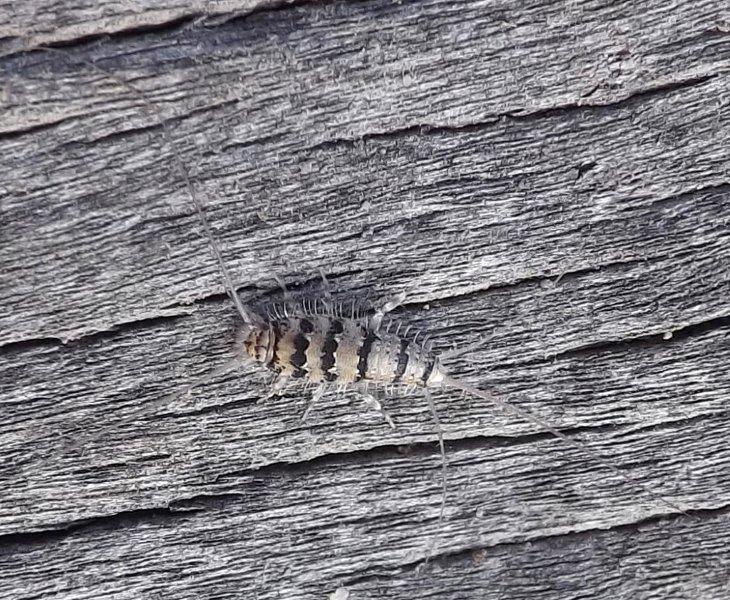
  Sue has photographed quite a few creatures that we previously knew very little about. She has found several species of ‘Fish moth’ which are neither fish nor moths and would normally be completely overlooked but they are actually quite attractive….
   This one is a Lepismatid, with a body about 15.mm long and those long antennae at one end and cerci.at the other make up a further 40mm or more. Sue found it under a piece of dead Mopane wood while I was helping some tourists whose car had a puncture – no chance missed to ‘collect’ a new specimen!
    As well as the ‘creepy-crawlies’ we’ve also added some reptiles and a few mammals to the museum. I love this photo of a large Water Monitor we found at Mandavu Dam, looking towards the camera….


   And this is one of our few mammals, a horseshoe bat found inside a huge, hollow Baobab near the Mbala river.

  There were three or four of them in the tree but they were very difficult to photograph so I climbed inside for a closer look whereupon this one flew out and perched beneath a branch where we were able to see it and photograph it clearly.  We’re hoping to add some snakes to the museum now the warmer weather is coming and they are starting to move around but if we find a snake in a hollow tree I won’t be climbing in for a closer look – even in the interests of science.


Friday, 5 July 2013

Baboons

   I must confess I’m not all that keen on baboons. Back in the days when I worked as a guide I was sometimes grateful to a troupe of baboons for providing a bit of entertainment on a slow day but usually they are just a little too human for comfort. It probably didn’t help give me a favourable view of the species that, back in 2008, Sue and I spent three months camped by the Zambezi with a well-used baboon roost not much more than a hundred meters away. The early morning noise of their constant fighting was annoying enough but the smell when the wind was in the wrong direction definitely ruined any chance of my becoming a baboon fan.
   Here in Hwange we don’t see all that many baboons. There is often a group to be seen somewhere near Mandavu and also at Masuma but at Sinamatella itself they were too afraid of people to be seen often. Until recently that is…..
    I think the problem is the enormous invasion of stink bugs we suffered back in March. There are still hundreds, if not thousands of them hiding in cracks and crevices and the baboons seem to like eating them.
   They search under the potted-plants on the veranda but sadly they are none too careful about the plants themselves and most of them have been broken…..

If we are careless enough to leave anything else on the veranda they are sure to tip it over…..
    

They break open our aloes to find bugs hibernating between the leaves….


They’ve even started lifting the table cloth and tearing up the table itself to find bugs hiding in the joints…


But worst, they are dismantling the various walls that edge the ‘garden’ and peeling the plaster off the house itself ….


   Even when we are at home the baboons are not as afraid as we would hope. Sue was busy working at the computer a few days ago when she heard a noise behind her, turned and found a baboon trying to open a window to steal some oranges. If we go out and shout, they run……


   But if they don’t see us they stroll nonchalantly past……


Or, more often, help themselves to a drink from the bird bath, all the while keeping a careful eye out for danger….


   Now I have to admit that one is quite cute, and so are this mother and baby…


   And of course they are simply behaving naturally, exploiting a good food source in a harsh environment but it’s hard to remember that when another potted plant is broken, the contents of the dustbin are blowing all over the garden, another piece of wall has gone and the spare engine oil has been tipped over. One good thing though, they don’t roost near here so we don’t have to put up with the smell.


Robins Camp

Google
As part of our efforts to get Parks rangers involved in bird atlassing, we were at Robins Camp a few weeks ago. Robins is about 75km from Sinamatella but sadly we hardly ever go there.
The camp is named after H.G.Robins who farmed in the area and then developed it as a game reserve in the early part of last century. A tower was built at the homestead in 1934 and it now houses a small museum in memory of Robins. While I was busy talking to rangers about the bird atlas project, Sue visited the museum and photographed a few of the exhibits.


   Robins is buried close by…


    And the sense of history is maintained by various items scattered around the camp.

 
Remains of an old cart                            Inscription on one of the axles.

   The tower is not a particularly beautiful piece of architecture but it is kept neat and tidy


   From the top you can look down on the camp itself, which is also well kept


   Not everything is in complete working order of course


As a lover of Land Rovers I would have liked to have taken this one home but we already have several others in similar condition waiting for repairs and/or a miracle.
It is many years since we stayed at Robins as tourists and I remember very little about it apart from a hyena coming and stealing cutlery from next to our cooking fire one evening but this visit has whetted my appetite for a few days holiday in the area and I look forward to returning soon.


Sunday, 30 June 2013

Early winter 2013

Google
It’s a very long time since I added anything to this blog – not through lack of interest or lack of anything to write about but for numerous other reasons, mostly to do with our internet connection. We have continued to be very busy at Sinamatella and we also had a couple of weeks in Bulawayo while we waited for the gearbox on our hard-working land Cruiser to be repaired so we’ve had some time off as well. Over the next few days I’ll be posting a few blog updates on what has been happening in this early part of the dry season, starting with a general look at the Sinamatella area……
    The most obvious feature of this winter so far is that there is still plenty of natural water available, even as late as the end of June. Luckily I don’t take most of the photos for this blog because I would illustrate the water available like this…..

Tshompani Pan, 17 June 2013.

Or like this……..

Tshompani Dam, 17 June 2013.

Whereas Sue prefers to take much more attractive photos like this…….

Mambane river

Or this……
Mandavu dam

Or this……..

Full moon rising at Chawato

Not everywhere still has water. Inyantue Dam is completely dry…

Inyantue Dam, 29 June 2013     

And the Lukosi River has water only just under the surface but the elephants know how to dig for it….


It’s very noticeable that the animals, particularly elephants are still not back in most of their usual wintering grounds. Below Sinamatella Hill we are only seeing a few Zebra, plenty of Impala and occasional Elephants. The usual winter herd of buffalo has appeared from time to time as well, numbering around one hundred and fifty at the moment. In the last few days Elephant numbers have been increasing at the dams and the natural pans around Tshompani…

Masuma dam, 28 June 2013     

And we have met a few closer to home but they are sometimes still quite nervous of cars, raising their trunks warily to catch our scent and decide if we are a threat….

With the water level remaining high at Masuma, there are still around eighteen hippo resident. We found them sunbathing out of the water when we passed by recently….

They are looking pretty fat, thanks to all the grass available nearby….


A waterbuck with her pretty little calf also came by while we were there but animal numbers in general were nowhere near as extreme as last year’s June count when we saw over 1100 elephant in 24 hours…


Finally, the Wild Dogs have been seen quite regularly again. I met a pack of eleven along the Lukosi River on my way to collect rangers. Sadly one of them had a snare around its neck with just a bit of the wire showing to one side …

 The snare seems to be made of steel cable and I know from experience how difficult that is to cut so it is amazing that the dog had broken free. Presumably another member of the pack chewed through the wire. The snared dog didn’t seem to be in much distress but unfortunately it will almost certainly be killed by the snare in the end as it will be almost impossible to find and dart it.