Sunday, 22 April 2012

Winter is coming

Suddenly, it seems, winter is coming. This morning it was almost too cold to sit outside on the veranda for breakfast but, in typical winter fashion, a few hours later it was hot and sunny. The first trees to lose their leaves are the Commiphoras and Kirkias. They grow best on the steep hillsides around here so we have a beautiful yellow-leaved Kirkia outside the house for a few days…..


And hillsides seen from a distance stand out yellow from the still-green Mopane around them.


On the main road from Hwange to Sinamatella

As the pans dry up, some of them get a covering of aquatic plants. This one, near Mbala, is unusual, covered in water lilies and very attractive to various water birds.


This is the time of the year when a lot of birds are flying north to spend a few months in the northern summer so we no longer hear the cuckoos and bee-eaters whose calls are such a feature of our rainy season. Some species of Kingfishers are well known for accidentally flying into buildings while they are on migration (I have no idea why!). A few weeks ago a Pygmy Kingfisher flew into one of the windows of our house and yesterday this Grey-hooded Kingfisher flew into the very same window, temporarily stunning itself.

Grey-hooded Kingfisher

   When it had recovered sufficiently I put it on a tree and it eventually flew away, no doubt with quite a headache.

   This is also the time of year when the Parks staff start preparing for game water pumping. The engine for the pump at Masuma was recently given a new concrete slab to replace the one that fell apart with the vibration last year. Gary Cantle has been working on the wind pumps at Shumba and Tshompani and has got both of them working.  Our solar pump at Bumboosie South has been running nicely for some weeks since we re-started it for the dry season but last week the outlet pipe developed a leak directly above a join in the electric cable, causing a short circuit. Masterly inaction solved the problem – we were unable to get to the pump for over a week and in that time the join dried out and the pump re-started!
   Yesterday I went to Inyantue to collect Rangers from patrol. It was a beautiful morning with a clear blue sky and a cool breeze. I was enjoying the drive too much to be in a hurry so I stopped to look at birds at both Mandavu and Masuma Dams. The dams have plenty of water but not as much grass as you might expect for the time of year.
   Mandavu Dam

Masuma Dam

Close to the turn off for Robins Camp, I met a pack of twelve Wild Dogs sleeping under a large Mopane tree. They had obviously been feeding as many of them were heavily blood-stained. Although they were close to the road they were not easy to photograph but eventually these two moved out into the open.

 The rest of the trip to Inyantue was less exciting. We were held up six time by fallen trees and once by a very stubborn elephant who had found a patch of green grass by the side of the road. He simply would not move away. We shouted, clapped our hands, whistled, revved the car engine and banged on the car door but he wasn’t concerned. In the end one of the Rangers threw a small stone at him and he ran as if we had shot him. Elephants are strange animals sometimes.

Meanwhile, better news on our finances. Trevor has saved the day by organising a grant that will top up the support we still get from SAVE and keep us in the field for the next twelve months. He has also been working on the Victoria Falls end of the Rhino Sanctuary proposal.
This is the beautiful spot next to the Zambezi where we are considering building the Sanctuary.


 If I was a rhino I’d want to live somewhere with a view like that!


Friday, 6 April 2012

More on plans for a rhino sanctuary

      The proposal for a fenced rhino conservation area is taking shape fast. We have agreement in principal from National Parks although final approval will only come after the plans have been thoroughly investigated. To get that started we have spent a few days doing some vegetation analysis for the proposed area. Sinamatella is very lucky to have Ranger Richard Ndlovu available to help with this sort of work.

    Richard has a wide knowledge of trees and shrubs and can name most of the trees around Sinamatella in Latin, Ndebele and English. Sometimes in Tonga as well! At the end of 2011 Richard was hospitalised for nearly a month after being bitten by a spitting cobra. We’re glad to have him back in the field.
    Another expert for this sort of work is Wildlife Officer Mercy Maganga who carried out a survey of the plant species eaten by Black Rhino back in 2009. Mercy accompanied us on our first day of analysis and found, as well as lots of rhino browse, an unusually large Leopard Tortoise.


   We already knew the area we were investigating quite well but approached the job as scientifically as we could, collecting data from random quadrats chosen by computer on a map. We then walked in by GPS to each point in turn. The data collection was quite easy and quick but there was a lot of walking involved so it took three days in all.
     As expected, we found the ground varies from very open Mopane scrub…..


       To quite dense Diospyros and Combretum bush…….


    The rhino don’t like Mopane but our results so far show that most of the area is covered with good browse and we are confident we could keep up to five rhino within the fence without having to feed them.
      After finishing our vegetation data collection, Sue and I went to Victoria Falls to do some desperately needed work with Trevor on our financial situation. Sadly, after three years of fantastic support, the SAVE Foundation has decided to consolidate its rhino funding in the areas that still have reasonable numbers of rhino and will reduce its support to us significantly for the next three months - then decide whether or not to continue at all. At the same time as we got that bad news, we heard that the company that has been sponsoring our fuel supplies has been forced to close, so suddenly we find ourselves without the money or fuel we need to carry on. It seems odd to continue working on our hugely expensive fenced sanctuary scheme at a time when we are not sure that we can stay in the field even to the end of the month but we honestly believe it is a worthwhile plan and we hope to find a way out of our current difficulty. Perhaps we’ve seen too many reality TV shows. They always seem to have a moment where someone has just one last chance to do something or other and it invariably works out OK in the end. Here’s hoping real life can imitate “reality”. Just in case, I’ll be searching the area at the end of this rainbow I photographed last week. A crock of gold would be very useful right now!


Thursday, 22 March 2012

Bulawayo

     OK, I know this is called the Hwange blog but we were in Bulawayo last week so I thought some scenes from the big city would make a change.
     Bulawayo is Zimbabwe’s second city and the main city in Matabeleland.  Sue and I are never quite sure where we would call ‘home’ – Sinamatella where we spend most of our time, Mlibizi on lake Kariba which is a sort of spiritual home, Hwange, Victoria Falls or Bulawayo where our family house is? I suppose Bulawayo has the best claim to being home and, much as I enjoy the bush, it’s always a pleasure to be there.
     Our house is in a small-scale farming area right on the edge of Bulawayo. We approach the city from the north and our first view of it is………


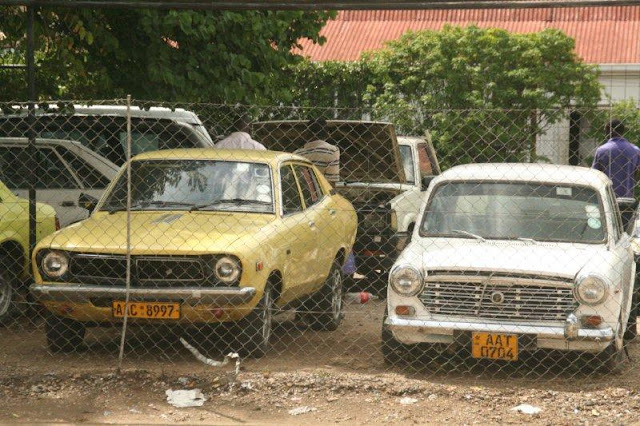
   As you can see, there is not much modern architecture in Bulawayo. In many ways it is a city where time seems to have stood still. The cars for sale are not exactly up to date……


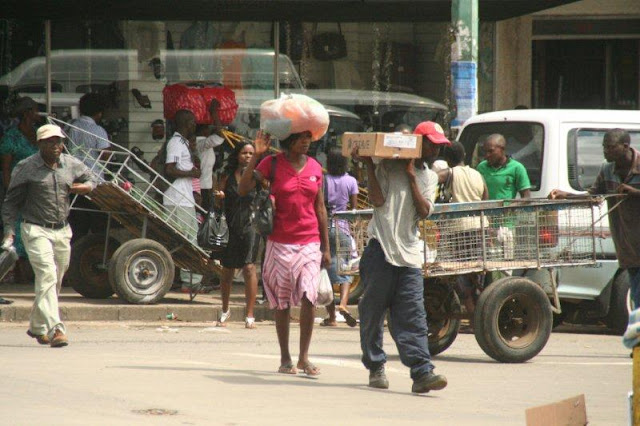
    A lot of the other transport is pretty old-fashioned……


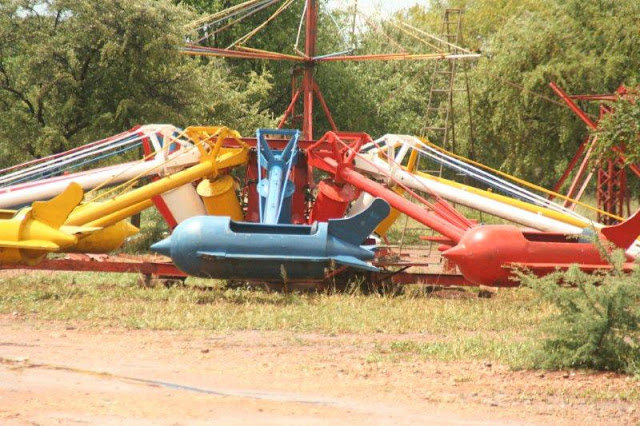
   And the “Luna Park” travelling funfair which is just setting up on the edge of town has a distinctly 1960s look.


  Bulawayo’s streets are famously very wide. This is Main Street, looking towards the city centre


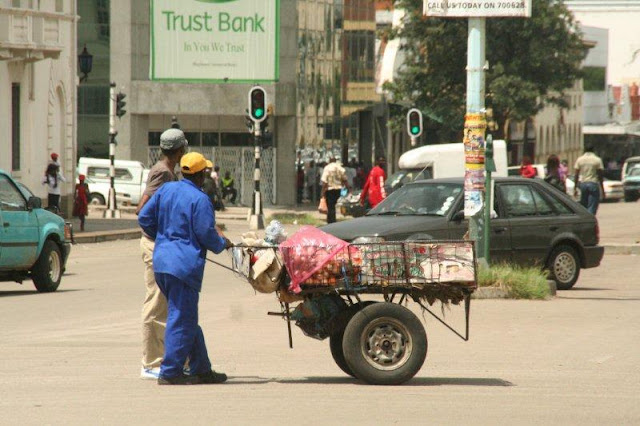
    Not much traffic in that picture and the same applies even in the central business district where there is still room for hand-carts (known throughout Zimbabwe as ‘Scanias’) amongst the cars.


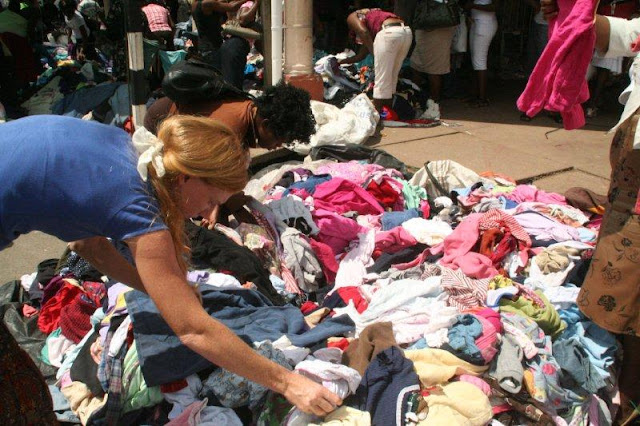
   There is a clothes market near the City Hall every Saturday. The clothes range from heaps of second-hand to smart new and Sue and our daughter Alison seem to enjoy searching for bargains….


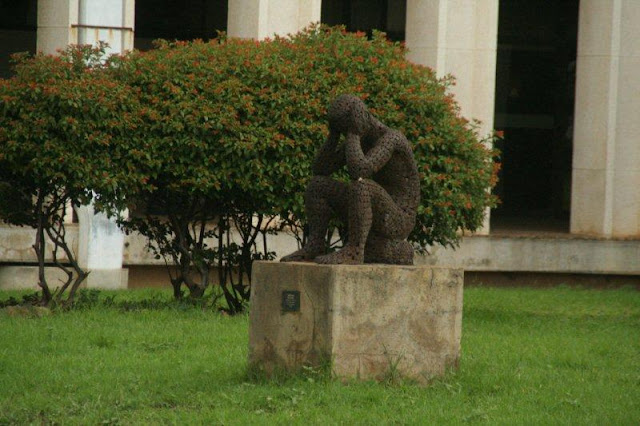
    I spent two hours sitting in the car waiting for them. Close to where I was waiting is this statue. That's exactly how I felt as well........


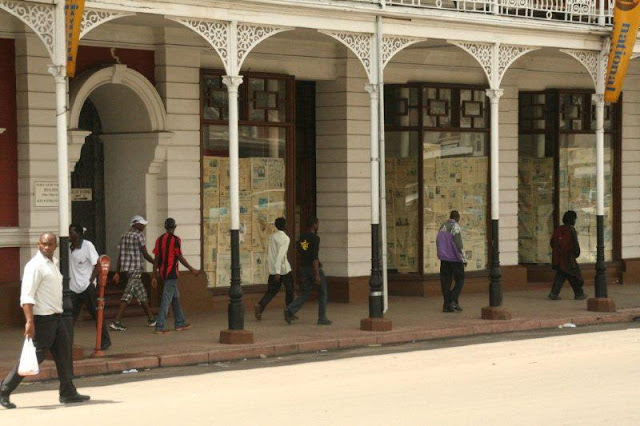
   Bulawayo has an Art Gallery in a beautifully restored old building. Some years ago an exhibition was mounted in which paintings representing the “Gukurahundi” killings of Ndebele people back in the early days of independence were put directly onto the walls. The killings are a sensitive subject and the Gallery was quickly forced to cover its windows with newspaper so that the exhibition was not visible. They remain covered to this day.


   Back at Sinamatella after three relaxing days at home I found a big anti-poaching operation about to get under way. A large number of police support unit, rangers from Main Camp and Umtshibi and rangers from Sinamatella are being deployed for a while to do an anti-poaching sweep and it is intended that the operation will be repeated as often as possible. Recently the poachers have been targeting elephants as well as rhino. Hwange has plenty of elephants but that’s no reason to let them be killed of course so anti-poaching operations will continue as long as there are people elsewhere in the world who put a high value on tusks, bones and horns.


Tuesday, 13 March 2012

News

     We have some good rhino news to report for once. Last month Nick and his colleagues at Main Camp found their White Rhino number 27, hiding in thick cover with a tiny new baby. Unfortunately they were not able to get close enough to see the sex of the calf and they didn’t get good photos but it’s great to hear about an increase in numbers rather than a loss for once.
   The supposedly pregnant female at Sinamatella hasn’t produced a baby yet. I was with rangers monitoring her for a day last week. We didn’t see her clearly for more than a few seconds at a time but she certainly looked big. Whether or not she is pregnant, only time will tell.

    It has been clear for a while now that we are not winning the battle against the poachers and there is no sign that the demand for horn will reduce in the near future. It seems impossible to keep a large wild population ranging at Sinamatella so we have been looking at alternative strategies. Trevor and I have been working for some time on a proposal to put up a fence around about ten square kilometres of good rhino territory at Sinamatella and protect at least a breeding nucleus of rhino within that. It is a strategy that has worked well elsewhere and we are confident it can be successful here.
    Trevor has also looked at the idea of a much smaller ‘rhino centre’ at Victoria Falls that can support one or two rhino for education and tourism purposes and raise money for the bigger Rhino Conservation Area (RCA) at Sinamatella. He has identified suitable land and approached the town council about using it and has received a lot of backing for the idea, including from the National Parks hierarchy. We have now started working on getting proper approval for the project from National Parks at Sinamatella and then up through the chain of command to Head Office in Harare before the really difficult bit – raising the money.  I’ll keep you posted as things progress.

     Meanwhile, this post started on the subject of rare babies, let’s finish with something about much more common ones. We have in Zimbabwe (and elsewhere in Africa) a bird sometimes known as the ‘feathered locust’. It is the Red billed Quelea which feeds on small seeds and can be a tremendous pest in small-grain crops like wheat and sorghum.
 
Male Quelea in breeding plumage.

   At this time of year when their food exists in super-abundance, the Quelea breed in colonies of up to millions of birds. We currently have a colony forming below Sinamatella Camp where there are probably tens of thousands of birds building their nests in a patch of thick bush near the old rhino bomas.

 
Nest building.

   Each bush can hold many nests close together and the noise of the birds is clearly audible at least a kilometre away. When the eggs are laid and start to hatch predators, from snakes to eagles to Jackals and Mongoose will gather to rob nests or feed on babies that fall out but thousands will survive. A Quelea colony is a noisy and rather smelly but fascinating place. We’ll try to follow this one as it develops.

 
Nests are close together


Sunday, 11 March 2012


Sue is still adding to our large collection of early morning photos, but as usual, when the view is like this it is hard to resist.
 

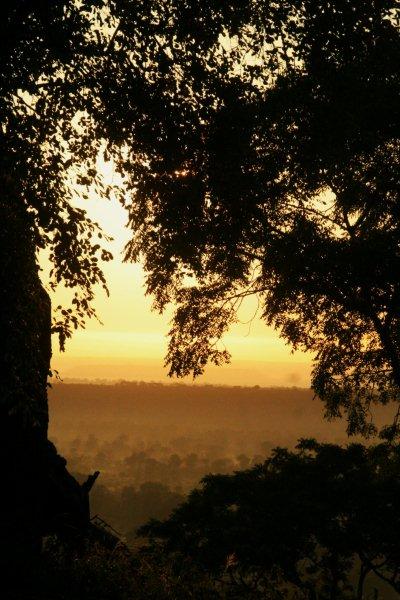
Looking towards the sunrise from Sinamatella hill.

A day that starts as beautifully as that has got to be good, even if it rains…….

Rainbow over the flood plain

The Impala are getting fat on all the good food, but we still haven’t got a photo of any of this season’s babies. They just won’t stand still to be photographed.

Near Mandavu

The trees and flowers are also doing well of course.
 
Seed head of Natal Mahogany Trichilia emetica

Aloe flower with dragon fly

And even though the rivers are muddy, they are full of water.

 
But the rainy season isn’t all gentle. We had a terrific storm one night a week or two ago. From inside the house it sounded as if the world was coming to an end and the wind was so loud we didn’t hear this tree come down, right by the house.


There was not too much damage around Sinamatella. A lot of branches had been blown around.
 

And leaves were stripped from some of the trees. The wind was so savage that Sue found leaves that had been impaled on the thorns of other plants by the force of it.

 
   When I went up to the camp site in the morning to check for signal from any of our implanted rhino, I found there were campers staying right on the edge of the hill. They had slept through the storm in a roof-top tent and I asked them how they had managed not to be blown away and they said they had sat inside the tent and held it together with their hands. They seemed to be completely unconcerned!
   I made a trip out to Tshakabika that day. We covered just 58km but it took nearly ten hours, most of them spent with two rangers trying to get the car out of a deep, muddy gully. I didn’t have the camera with me so I have no photos of the situation as it happened but Sue was on hand to get a photo when I came home.
 
Not a pretty sight


Wednesday, 22 February 2012

February 2012 so far...

Thanks to the SAVE Foundation we have been able to reward some of the rangers that have been involved in contacts with armed poachers recently.


Senior Wildlife Officer Masara receiving rewards on behalf of some of the rangers – a few of them are in the background. Calington Sibelo who was at a contact in January had to be persuaded to take part as he was embarrassed not to be in uniform.

The saga of our on-off Red-headed Weaver nest has taken a new turn. After sitting for a few days, the female abandoned the nest and two or three days later new tenants moved in. They are Cutthroat Finches, which often take over abandoned weaver nests. At the moment the female is almost permanently inside, sitting on eggs we assume and the male occasionally visits. She also gets visited by another pair of Cutthroats who are presumably looking for an empty nest, but she scolds them loudly and won’t let them in. She is able to distinguish ‘her’ male’s call from the hopeful nest- seeking male and she never seems to ‘swear’ at the wrong one.


Male Cutthroat Finch

And the female before she started sitting on the eggs

This is the time of year when the elephants start to return. Yesterday afternoon there were over fifty down on the floodplain. The grass isn’t as high as last year but the smallest babies still disappear into the longer patches. Anyone who has visited Sinamatella will recognise the Palm trees…..


We are still only getting rain but it has been enough to make the grass grow long on the roads…..


Heading towards the Smith’s Mine Hills

I’ve been having a lot of trouble with grass seeds blocking the radiator of the car and making it start to overheat. This morning I stopped at a pan near Chawato to collect water to try to wash away a new accumulation of seeds…..

These temporary pans attract various species of birds such as these Comb Ducks that were on the pan when I arrived.


A pair of Comb Ducks. The male has a strange protuberance on the top of his beak that grows in the breeding season. This is the breeding season!

I noticed this morning that the grass is also rather long on the runway at “Sinamatella International Airport”. As you can imagine, we don’t get a lot of visitors arriving by air.


The runway at Sinamatella International.

If we did get some planes landing we might have to smarten up the airport terminal….

Airport terminal (Duty free shop, Car rental office – that sort of thing)

At this time of year the sky can be beautiful with masses of white clouds. Sue photographed this positively biblical cloud from Sinamatella Hill.

It really looks as if it should have a huge finger pointing out at some hapless sinner.

Crossing the Smith’s Mine Hills I was also attracted by the cloudy sky but my photo turned out in the end to be better as a landscape than a cloudscape….


The road across the hills has suffered a lot from the occasional heavy rain. Road maintenance has become a real problem as the Parks Authority don’t have the money to employ road gangs or to maintain a road grader and donors are rarely interested in funding that sort of thing. We have had a little help from Makomo mine on the Sinamatella access road but side roads such as this one need a lot of attention


And it is as bad as it looks!


Sunday, 5 February 2012

Good news and bad news

The rainy season always brings electricity problems and this year has been especially bad. We had a week without electricity up to yesterday. The ZESA engineers started work on the line after about three days and after they had fixed it they drove through to Sinamatella to tell us that all was well. Unfortunately while they were at the ops room passing on the good news a heavy storm struck and the lights went out again! It took several more days to make (we hope) the final repair.
    Once again, poaching has been dominating all our activities. There has been some good news with a Zambian gang located hunting rhino in our southern sector and put out of action in a contact with Sinamatella rangers. Sadly another gang was hunting elsewhere at the same time and they were luckier, killing rhino number 253 and escaping with his horns. National Parks brought in a helicopter to try to locate the poachers but they still got away. Yesterday we heard that rangers from Robins Camp have located spoor of eleven poachers moving along the border with Botswana. Such a large group is probably hunting elephants at this stage but two or three of them might move into Sinamatella and look for rhino during the period of the February full moon. With poaching pressure of this intensity it is almost impossible to protect any reasonable population of rhino. Only a decrease in demand for horns can be successful in the long run.
     Meanwhile, not everything is gloomy. The pair of Red-headed Weavers that built a nest on our veranda was unsuccessful at the first attempt when their nest was destroyed and the eggs were eaten by a predator. The birds disappeared for a few weeks but have returned, re-built the nest and are trying again. A lesson for all of us perhaps?


  We are not especially innovative with animal names. The weavers are generally  known as ‘Him’ and ‘Her’. This is Him!

     On a recent rhino monitoring trip we met up with a group of young lions. These are from the pride living around Mandavu Dam and are offspring of the Tequila Brothers – Jose and Patron.


 I couldn’t resist photographing this waterbuck posing as the National Parks badge

   We had a rest day last Sunday and went to Mandavu dam. A storm moved in from the west…..

In spite of the heavy clouds there was very little rain. People carried on fishing but this lady had to give up when something big – a crocodile perhaps, took all her fishing tackle at one bite and dragged it off into the dam!
Mandavu has a huge population of crocodiles, many of which are easily large enough to look at people as prey but luckily the dam has so many fish, the crocs seem to concentrate on those and so far there have been no attacks on people fishing. Let’s hope it stays that way.