Friday, 20 January 2012

Monitoring number 251

    Since I last wrote, the poaching threat has continued at a high level with as many as three groups of poachers known to be operating at one time. After the contact on the Botswana border we have also had a contact at Tshakabika in which five Zambian poachers were located. They had stopped to rest but cleverly they were sitting on the edge of some bush at the end of a clearing and they saw rangers who were following their spoor and fled. Unfortunately none of them was captured but they abandoned a lot of their equipment including a great deal of food and parts of a rifle so they will not be able to continue in the field.
   Today Robins Camp rangers also had a contact with poachers, thought to be the same ones that were surprised at Tshakabika. At the time of writing I don’t know if any were captured.
   Meanwhile Sinamatella rangers have been following spoor of a group of poachers for the past three days. Yesterday they got very close, finding a still-warm fire where the poachers had cooked a meal then later finding fresh signs that they had killed a warthog. Unfortunately rain late in the afternoon washed out the spoor and the rangers had to start all over again this morning.
    With all of this going on, I have been spending the days monitoring rhino number 251 who is, we think, very vulnerable because he is living in the same area the poachers have been searching. Two days ago we found him in such thick bush that I never actually saw him all day. It was the same yesterday and for most of today. Monitoring a patch of bush with a sleeping rhino somewhere inside it can be pretty boring but today was enlivened by a giraffe who didn’t detect us until he was very close.

   Even when he eventually smelt us he wasn’t at all sure where we were and simply ambled away looking puzzled.
    Late in the afternoon the rhino woke up and came towards us, feeding occasionally if he saw anything that looked tasty. We moved parallel to him with the wind in our favour and I eventually saw him for the first time in three days.

    He was so engrossed in feeding that we had a bit of time to try to set up a photo – Bigson in the foreground and the rhino behind.  


  The rhino is that little grey blob by Bigson’s hand. No photographic prizes here!
     

   Two days later……..
  Well nothing much has changed in the past days. No sign of active poaching gangs but we have continued monitoring number 251. He always seems to be in the very thickest of cover where he is difficult to follow.


  Moving through places like this certainly gets the adrenaline flowing.
  Yesterday I was out with Prosper Chikande and ‘Major’ Mbewe.

      Another poor photo I'm afraid. Prosper and "Major", bottom right, with telemetry!
      It took us just over seven hours to find the rhino and then we came upon him so suddenly and were so close that he mock charged before turning and running. Mbewe, who was hospitalized after the rhino attack last June was a little shaken to be subjected to a charge at close range again but, to his credit, he stood his ground and will no doubt be on patrol again tomorrow!


Saturday, 14 January 2012

New Year

   We spent Christmas and New Year at home in Bulawayo with our family.


   We returned to Sinamatella to find that the rains have apparently deserted us already and a lot of the pans and springs are starting to become pretty dry. There’s no need for worry just yet as the rainy season has a long way to go and I’m sure we will have plenty of rain before it ends.
  We had visitors staying with us last week. Aurelie, who has been with us before as a volunteer, brought her partner Rafael to see Zimbabwe and they spent three days at Sinamatella relaxing after a tough 2011 at home in France.

Another very welcome visitor was Trevor, who spent a couple of days with us planning the year ahead. We found time to go out and check on the pump at Bumboosie South and saw some wild dogs at Salt Spring on the way.


The pan at Bumboosie South is by no means full.

But the solar pump is working well and keeping the trough full.


We  also went to Tshakabika Hot Spring. The photo shows how dry the surrounding countryside is considering the time of year

But there’s still long grass in places…..


   While these various visitors have been with us there have also been less welcome visitors in the area. Spoor of five poachers was detected heading in our direction last week through the Robins camp area. Thanks to the transmitters fitted to many of the rhino last year our Rangers are able to try to protect them by locating them every day. One or two of the rhino don’t seem to understand that we are on their side. Number 87 (“Major”) who attacked us back in June last year charged a group of rangers on Saturday, injuring one of them slightly. Number 251 has also proved a problem, wandering such large distances each day that he is very hard to find. We located him today with a mobile team and will be looking for him again tomorrow as the poachers are almost certainly still in the area, taking advantage of the full moon to move around at night as well as by day.
   It isn’t only the rhino that are being difficult. Ranger Richard Ndlovu was bitten by a cobra in early December and has been in hospital ever since. He is slowly recovering. Thinkwell Nyathi also had a run-in with a snake, being spat in the eye by a Spitting Cobra. Luckily he had access to water and immediately washed the venom out so he has recovered fully.
   Finally, whatever other New Year resolutions Sue made, she clearly didn’t resolve to stop taking photos of sunset and sunrise. Here’s her latest addition to our already huge collection – Sinamatella sunrise, 5.48 am, 9 January 2012. Worth waking up early for…..


UPDATE......This post was delayed by an internet connection problem. Since I wrote it the group of poachers I mentioned turned back, strayed into Botswana and was intercepted by the Botswana Defence Force. Unfortunately that wasn't the end of poaching for the season. Another group of Zambians was detected by Sinamatella rangers near Tshakabika this morning and they ran away, abandoning all their equipment. Yet another group has also been detected in the area (by their spoor) and the rangers are tracking them. As far as we know at this stage, no rhino have been killed.

Saturday, 17 December 2011

SAVE Foundation news

This week I received the following email from Nicholas Duncan, President of the SAVE Foundation of Australia……..

Friends!  In the last few days we are proud to announce that, for the first time in our nearly 25 years existence, we have cracked through the $500,000 barrier of donated goods to rhino conservation!  This, in turn, takes our total to more than $4,000,000 since we started in June 1987! Thanks to everyone who has been part of this amazing, record breaking year.  We have also raised a mammoth $470,000 to fund these donations.  As you know, we are not a high profile group and most of our income comes from hard work to run events at a profit.  We are not at the forefront of trendy causes and receive fairly small donations from the general public.

Amongst the donated items this year are;

1.       8 x used Landrover Defender 4wds.
2.       7 months of extraordinary specialized training for 117 rangers.
3.       Rhino monitoring support in all the Intensive Protection Zones.
4.       Lowveld Rhino Trust, where 80+% of the rhinos are located..
5.       Veterinary support for rhino management operations.
6.       Sophisticated tracking and communication equipment.
7.       Other conservation projects.

   That’s a fantastic effort in difficult financial times. Without SAVE, we certainly would not be here and I don’t think the rhino would be either. Many thanks to everyone involved.


   With water available all over the Park, this is the poaching season. I was out yesterday taking rangers to follow up on a human (presumably poacher) spoor that had been found right on the western edge of the IPZ.  Unfortunately the tracks were too old and faint for us to follow and we didn’t find the poachers but we did find something else that I’m not all that keen on – this large (approx 2,5m) python.

The business end of a python – before it started getting cross 

   I know I should try to like snakes but I’m afraid I just can’t bring myself to appreciate them. Sue and I particularly dislike pythons, having several times found them looking fat and well fed in our chicken house when we lived in Botswana and once having had a big one in our house at Mlibizi. That one not only invaded the house but also ate one of our cats which is not really the sort of behaviour to make people like you. The python in the photo was lying right across the road and it took us some time to persuade it to move. If we prodded it in the tail it turned and tried to bite but stayed on the road. I’ve seen those TV programmes where the presenter nonchalantly picks up all sorts of angry reptiles to show the camera but none of us was keen to do that and in the end we just threw sticks at it until it got fed up and went away!
  
   After checking the poacher spoor and spending most of the day investigating the area for any other signs, we returned to Sinamatella in the late afternoon to find that there had been very heavy rain. The floodplain below the camp was a real contrast to the semi desert that was there just a few weeks ago.


Sinamatella River flood plain, seen from the camp

We went out to see how the river looked from the
Sinamatella River Drive
and found it flowing strongly right over the bridge.


 For a moment I thought of driving across but many years ago we tried to cross the Umguza when it was in flood and our Land Rover was swept sideways and nearly over the edge of a bridge. Having experienced that once we didn’t take a chance on being carried away into this…….


Even a Land Cruiser would struggle in here!

…..so we turned round and drove home the way we came.
    We were surprised to meet an elephant on the road. Most leave Sinamatella in the rains, partly to find better food elsewhere but perhaps also to avoid the very soft mud that is so often associated with Mopane bush.

Walking in that must be hard work even for an elephant.

Back at Sinamatella, the day ended with a startlingly bright sunset. Sue couldn’t resist a photo though we already have hundreds of sunset pictures.

It really was this bright – no ‘photo shop’ involved


Sunday, 11 December 2011

    So far the Hwange blog has been mainly about rain. This post is partly on the same theme but anyone who saw the Park in October / November would understand why that is. What a pleasure it is to see everything bursting into life and the bush becoming green.
        A Red-headed Weaver is building a nest on our veranda. He showed it to his female when it was part-built (as in the picture below) and seems to have got her approval because he has carried on building and is now almost finished. Today the female came to inspect again. She spent quite a bit of time in the nest but hasn’t laid any eggs yet. We will of course be watching their progress closely.


I was out looking for rhino on Sunday and Monday. Sunday was a very long walk for no reward. We didn’t see a rhino but we did come across some marvellous pieces of fossilised tree which I couldn’t help photographing.

 
Dadoxylon sp, tree fossils. Around 200 million years old

   The rhino we were following obviously got a scent of us early on but it took us some time to work that out and meanwhile we had followed him a very long way from the car. It was a tiring walk back.
   On Monday we had more success, seeing one of the females that is under intensive protection. “Her” rangers were with her. They had been with her every day for most of their ten day patrol but a couple of times she wasn’t found because she seemed to have gone far from her normal range. I suspect she will do that more often as the bush becomes greener and food is widely available. If she does wander, other anti-poaching teams are now in place to pick up the signal from her transmitter and try to protect her.
    Sue and I spent Wednesday and Thursday helping with ranger deployments

 And Sue took some photos to illustrate the green theme.
The road to Surichenji

 New trees sprouting next to the stump of a Mopane burnt in this year's bush fires

After the rains I was worried about using the dreaded “Tractor Hill”. Here’s the reason it has that name (picture taken in 2009)

 
Rather than have an accident on a muddy surface and have to rename the hill “Tractor and Land Cruiser Hill” we took a different route which the rangers described to us.

I wasn’t too sure of the way as it took us right out of the Park towards Hwange town but the directions were good, the road was pleasant and we didn’t get lost.
We even saw some good birds.

Ground Hornbills in flight

After two days of deployments, we went back out looking for rhino. This time we went to an outlying area just to see if there were any rhino around. On our way we crossed the Lukosi River. Not much water yet.
 

   We camped close to the edge of the Park and I walked in with Rangers Mbewe and Sibanda to the area we wanted to search. For the first couple of kilometres I was constantly aware of a strong scent of flowers but couldn’t see any. Eventually I realised it was the Crocodile-bark Diospyros which has tiny yellow flowers. They smell strongly of limes.


   In the Pongoro Hills the rangers tried the telemetry in case any implanted rhino were close by. There was no signal.

The scenery was wonderful – reminding me of the Matobo Hills.


A waterfall in the hills - but sadly there hadn’t been enough rain for water to be running.

  We walked around 17km but didn’t see a lot of animals during the day, just a few elephants, some kudu, zebra, klipspringers and an assortment of small things…..

A leguaan (Rock monitor lizard)

Meanwhile, back at camp……

On another day we drove to Chibungo springs. There was a lot of water, plenty of browse but absolutely no sign of rhino.

Ilala Palms at Chibungo springs

The springs are on land that was once known as De Rust Farm but was incorporated into Parks land in the 1950s. It must have been a fantastic place to live.

Ruins of De Rust farmhouse

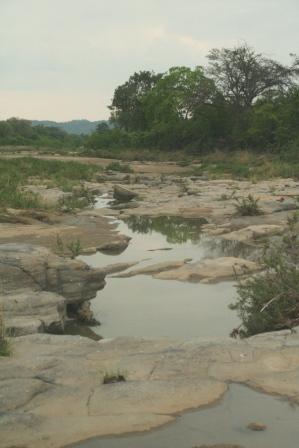
We had a lot of rain on our last night in camp and found the little river near our tent flowing in the morning.

On our way back to Sinamatella we found hippo spoor along the road for several kilometres. Some of the hippo wander when the weather is suitable to get away from the crowding and competition from others at Mandavu and Masuma.


 So, in three days of searching we saw a lot of things but no signs of any rhino. It wasn’t as easy as working with the telemetry for implanted rhino but still very enjoyable of course. Back to the telemetry this week though I think.

Thursday, 1 December 2011

Anti-poaching news

For obvious reasons, this posting, which is mainly about anti poaching, will be a bit short on actual detail but I hope it will give an idea of what is happening now at Sinamatella.
   Back in September the majority of the remaining Black Rhino were darted and fitted with transmitters (telemetry). This was a big operation involving Parks and a number of NGOs including ourselves. ‘Rhino Ops’ as it is known is exciting but also, in many ways, sad. Sad to see the rhino brought down, their horns partly removed, blood samples taken and so on as well as sad that it is all necessary.

Chap Masterson (Govt vet dept) and Ray Makwehe (Nat Parks, Umtshibi) fitting a transmitter to rhino number 251, a young bull we knew as “Mummy’s Boy” because when we first met him he was only semi-independent and was often seen close to his mother.


  However, in spite of the unpleasant aspects of Rhino Ops, I’m delighted that the transmitters were fitted.
   Where, in the past, we often took three days to find a rhino, we can now find them within an hour or so. We have recently done some extensive trials, tracking with the telemetry and found that we can reach most of the animals soon after the sun comes up and remain with them throughout the day. When the moon is bright it is possible to be with them by night as well.
   This means that all the known females now have rangers guarding them closely throughout the day and we are doing the same for many of the males. One of the animals I have seen a lot lately is exceptionally sleepy and is usually fast asleep in thick bush from early morning, staying that way all day. Not a very exciting rhino to monitor.


This isn’t a bad photo. She really is this hard to see!
  
  Another hardly seems to sleep at all and I have no good recent photos because she always seems to be moving and alert so she’s hard to approach. She’s difficult but interesting to monitor all day.
   Strangely, the one who attacked us back in June is like the sleepy female, easy to approach and rather boring

  This is a view of him (shown by the yellow arrow) I had for some hours last week. It gave me time to look around and notice things like the funnel web spider below.

The spider is just visible at the centre of the web.

  With armed rangers permanently monitoring the remaining Sinamatella rhino we hope to be able to keep the poachers at bay for the foreseeable future. It was worrying to see that the total number of rhino lost to poachers in South Africa so far this year already exceeds last year’s unprecedented number. Sad also to read that Vietnam has recently announced the loss of its last rhino. I hope that is an announcement Zimbabwe never has to make.
    On a  personal note, Sue has been visiting Bulawayo but is back at Sinamatella now so the standard of photography should improve.


Sunday, 27 November 2011

The rain has begun

The first post on this blog was mostly bad news about drought. We have since had some rain so here, to balance the harsh photos in the first blog, are some nicer ones. Hope you enjoy them. (I don't have reliable reference books for flowers so I am not absolutely certain of the correct names but I'm sure no-one really cares!)

First rain coming……..
 
Looking across to the Smith's Mine Hills from Muchininga Ridge


After the shower…..
Found amongst rocks near Bumboosie Ruins

Ammocharis tinnea……
 
Flowering in the Mopane, near Kashawe View

Lapeirousia odoratissima
 
Near Kwizizi


Fast asleep!

 
The rhino that attacked us back in June - but in a better mood than he was then.

Tuesday, 22 November 2011

   Welcome to the new “Hwange” blog. This will, I hope, continue where the “DART blog” left off some time ago.
    The main topic of conversation these days as we wait for the rain, is heat. Even at breakfast time, before 7.00am, we have to sit in the shade of the pillars out on the veranda to avoid the uncomfortable heat of the low sun. By mid afternoon there is nowhere to escape. Outdoors the heat is intense and the leafless trees give no shade, indoors the fabric of the house has heated up and it remains stifling long into the night. October 2011 was said to have been the hottest in Zimbabwe for 50 years with many places, including Sinamatella, recording temperatures in the forties. November hasn’t been any cooler so far.
    If all this is uncomfortable for us, it’s worse than that for the animals. The 2010/2011 rainy season was patchy and ended early so the dry season has been longer than normal and the vegetation cover was poor at the start. Now it is almost non-existent. In the Kalahari sand parts of the Park the critical issue is water with the pumped pans struggling to provide for huge numbers of desperate elephants. Around Sinamatella the springs are still running well and water is not the problem – food is what the herbivores need. As a result animals are dying all around the Park, from the heat, lack of water and lack of good food.
   Yesterday we were at Mandavu Dam and the contrast of the still good water supply with the bare surroundings was stark.
These Zebra appear to be standing in a desert. In fact they are just a few meters from the largest remaining sheet of water in the Park…..


…but water without food is no use.
     So far the most obvious deaths have of course been elephants. When a small animal dies the carcase is soon eaten but a dead elephant stays around for a long time. We have been seeing mostly medium sized carcases such as these two at Manga 3.


But there are also plenty of small ones.


    We can only wonder how many small animals of other species have died. We have noticed greatly reduced numbers of small birds such as Firefinches, Blue Waxbills and Grey-headed Sparrows coming to our bird bath but whether or not that is due to birds dying we don’t know.
    On the bright side, there are of course some animals that are positively thriving at the moment. We have never been so aware of vultures

And no doubt the Hyenas are pretty cheerful as well.


     This is all just part of a natural cycle and arguably the Park will benefit from losing some elephants for a few years but that doesn’t make it any easier to live with and I hope the next posting to this blog will have numerous pictures of rain and green grass.