Sunday, 13 January 2019

Mandavu Dam Wall


     If I had made any New Year's resolutions (I didn't) I might well have resolved to post to this blog on a regular basis and I would already be close to breaking my resolution. That's entirely normal of course but... I would have an excuse (and a real one at that!) For some time after we got back from our Christmas break, we were without a reliable internet connection. Eventually we discovered that the problem was not some arcane bit of IT or satellite programming that had gone wrong but something we could solve fairly easily - the mounting for the satellite dish was coming away from the wall and putting the dish out of alignment. I fixed it back up and it seems to be OK now, so here goes......

   Mandavu Dam.
    Fourteen kilometers from Sinamatella is the biggest body of open water in Hwange National Park - Mandavu Dam. It's a hugely productive dam, thanks to the nutrients introduced by the hippos and the hundreds of buffalo, elephants and others that drink there in the dry season so it is popular with anglers who are allowed to fish there at weekends. It's also a vital part of Sinamatella's game water supplies, and an important breeding and feeding place for numerous birds.


 We pass the dam regularly and often spend time there counting and listing birds but until recently we had never given a thought to the maintenance of the actual dam wall. I'm certain we wouldn't have thought of it now if Colin Gillies from Wildlife and Environment Zimbabwe hadn't e-mailed me with some concerns over the state of the wall. I knew about as much about dam wall maintenance as I do about computers (i.e. next to nothing) so I asked my good friend Professor Google for help. He, of course, knows more or less everything, and as I read through various websites that he suggested, I became more and more concerned.
   The first thing I was sure we needed to worry about was trees. Apparently, trees on an earth dam are a disaster waiting to happen. Mandavu didn't have trees - it had a forest........


   The road across the wall - dam to the left, forest to the right!
   Next concern was termites and animal burrows. We have both of those all over Sinamatella so probably at Mandavu too but had anyone ever checked? Almost certainly not.
  Prof Google guided me to one website that gave a series of stages to look for to show any deterioration in a dam wall. First stage, in which there is nothing to worry about,  is a flow of clear water on the downstream side and the final stage, probably best labelled 'panic',  is a whirlpool in the dam itself and a strong flow of muddy water and debris downstream. As far as I could see, at that stage all you can do is 1. Run for your life and 2. Call the emergency services. I was pretty sure that we were far from that situation but not at all sure of anything else so Courage Mutema, the Sinamatella Parks Ecologist and myself went out to have a look.
   It was, as you would expect, a mixture of good news and bad news. The good news was that there was a small flow of clear water through the wall, there were no active termite nests (though there were some large ant nests) and no obvious animal burrows. The bad news items were that the wall was covered in trees, that many of the rocks which are meant to resist wave action (the technical term seems to be rip-rap) were out of place and that the road across the wall has eroded, causing rain water to pour down the back face of the wall where it has cut some fairly disturbing gullies.


Part of one of the gullies - not something you want to see in a dam wall!
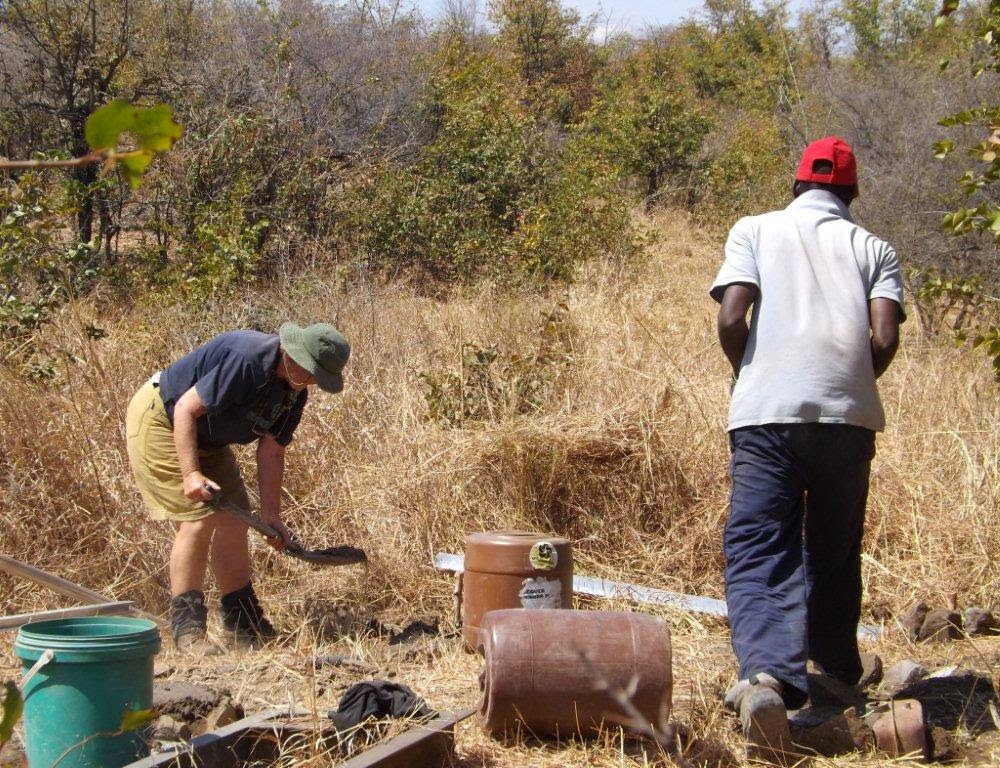
   The gullies were obviously something we should be dealing with very soon so we started work on them first. A proper solution to the problem will mean rebuilding the top of the wall to direct rainwater into the rip-rap but that will take some organising. For now, we have simply thrown tons of rock and brush into the deepest gullies and we'll try to cover them over with soil so that grass can grow and bind it all together. It would have been nice to have heavy earthmoving equipment to do this but that's way beyond our resources. Instead, we have manpower, and of course a Land Rover ....


   Removing the trees turned out to be a huge task. If they had been Mopane, as they would have been in most parts of Sinamatella, it would have been difficult enough but in fact they were mostly Acacia tortilis, which comes armed with both hooked and straight thorns..........


   ..........and strongly objects to being handled. It took us two full days to fell all the trees, cut them into reasonably sized pieces, winch them up to the top of the wall and stack them. By the end we were all heavily scratched and thoroughly fed up with the task but satisfied to have got it done. I will go and kill all the tree stumps with a strong alkali to stop re-growth and poison the ants whose nests seem to go deep into the wall. We will eventually re-build the eroded crest of the wall and spread the branches over it to protect the loose soil and encourage grass-growth. All being well, this is a lesson learnt and regular dam maintenance will become part of the annual work schedule at Sinamatella. We are grateful to Colin Gillies for pointing out what needed to be done - but I have to say, there were times as I pulled yet more hooked thorns out of my skin, when I wasn't quite so grateful!

Tuesday, 11 December 2018

November 2018


  I haven't posted anything to this blog for a few years. That wasn't through laziness or lack of interest but simply because our computer became so out of date it was no longer able to add photos to the text - and without the photos I don't think there would be many people interested
   The possibility of re-opening the blog has arisen several times recently and eventually I thought I would give it a go - and my test-post worked so here goes........
   Bhejane Trust puts out a regular newsletter. It was, for a long time, a monthly effort but from the end of October 2018 it became bi-monthly. That means there was no newsletter  for November so this post will be a summary of what I would probably have written.
   I usually start with news on game water supplies. Normally by mid-November we can begin to relax because rain falls far out in the Park, the elephants (who are our main customers) leave and the water levels of our main pans and dams begin to recover. This year the rains were late arriving and November was very hot and very dry so we were under more pressure than we would have expected (or wanted). Our most important site (in that it attracts the most animals and the most tourists) is Masuma Dam. By the 10th November the level of the dam was way down on normal.....

  A reading of the meter at the solar/diesel pump that supplies the dam showed that we were pumping 86,000 litres per day. That sounds like a lot but when you  consider that there were over a thousand elephants drinking there each day as well as hundreds of buffalo, kudu, impala and others, it's clear that 86,000 litres is not enough.

                                          Elephants crowded around the trough at Masuma  
The weather forecast suggested we could expect rain soon so we decided not to panic, to keep the solar/diesel pump running and hope for nature to solve the problem.  However, a week or so later we realised that wasn't going to happen so we replaced the pump with one that runs purely on diesel and supplies a lot more water per hour. Camp Hwange, Kashawe Camp, Kapula Camp and Bumbusi Camp all chipped in with donations of diesel and for the first time in several weeks we were able to put more water into Masuma than the animals were taking out. The level of the dam rose and all was well but it was a close-run thing.
   Meanwhile, this happened at Shumba.........

                                         
  At first we blamed the elephants - after all, it wouldn't be the first time they have done something like this! Closer inspection though, suggested the damage had been done by strong winds. Either way, it put the pump out of action at a crucial time. It took us one day to travel out to Shumba, dismantle the mess and bring it back to Sinamatella, the next day to make a new frame from bits of the old one and a third day to get it all re-assembled. Many thanks to Antoinette van Wijk and Peter Mc Sporran-Edwards, who were with us at the time and put a lot of effort into helping to get this pump back in action. It was hard work, but very satisfying.
    I'm glad to say there were no other major breakdowns to contend with. Even so the situation at some of our water points was pretty hectic, with elephants drinking in large numbers throughout the day and most of the night.  Hard though it is, we have to accept that at some point it will become impossible to cope with the ever-increasing number of elephants in the Park and this November showed us how close we might be to that point. We will have to give that some careful thought during the coming rainy season.
  Wildlife
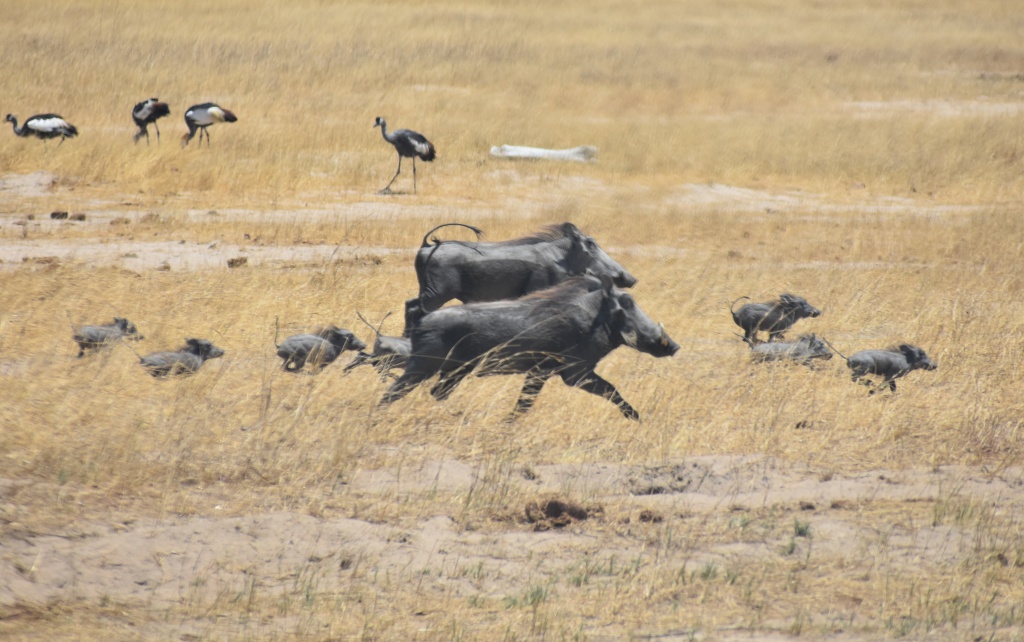
      Out in the Park, November was a great time for animal viewing - provided you didn't think too deeply about how tough the animals must have been finding their lives in the absence of decent rain. I felt sorriest for the females with babies. Every year, Sue tries to get decent photos of the baby impala with their long legs and Disney-cartoon faces and the baby warthogs - impossibly cute for such a bizarre-looking animal. As usual, this year neither species co-operated, running away long before Sue could get the camera lined up and these are the best she got (and I know she will be annoyed with me for using these pictures - they are not up to her preferred standard!).......

  
 Not all the young animals survived of course.

  It appeared that this little zebra was killed by a lion but abandoned in favour of the young elephant that was killed nearby by other members of the pride and is just visible in this picture, surrounded by vultures.

   Similar tragedies must have occurred in many other places - though of course they are not tragedies from the point of view of the predators and scavengers.
   At home in Sinamatella Camp, we were very much aware of the difficulties facing the animals as many of them came to forage in and around our house and to beg from us at meal times. It made for some easy photo-opportunities.......


 It's nice having all these animals around but of course it would be better if the rain would come and they could find plentiful natural food. It isn't far away ......... 


Sunday, 16 November 2014

Some dry season views

OK, my ‘Smith’s Mine’ post worked so here goes for the next instalment.
A lot happened in the six months gap between blog posts so I’ll just use a few of Sue’s nicer animal photos for this one…….
The dry season is, of course, the best time to see lions as they hang around at the water points and wait for their next meal to come along. We met this nice male near Salt Spring one morning……..


 A lot of lion sightings are just a patch of tawny fur and the occasional flick of an ear in the shade of a bush but early on a mid-winter morning even the lions are awake and it was a pleasure to watch this one walking through the bush.
  At Masuma the lions killed a buffalo just behind the dam wall where they were invisible from the viewing platform. Occasionally one or two of them would come to the water for a drink……


But a great deal of the time they were intimidated by some of the dam’s resident hippos


  The viewing platform soon filled up with tourists and we changed from lion watching to people watching. Wild animals are wonderful but sometimes people are even better!
    Just last week we were passing Masuma and the attendant warned us that there was a sick lion near the road. Down by the bridge we found one of the males walking slowly towards the shade with his face swollen, one eye completely shut and the other almost closed as well


   By mid afternoon he was worse, struggling to breathe and obviously suffering. He died an hour or so later. It seems he was probably kicked in the head by a large animal and died from the effects of the kick but there was a slight possibility of disease so samples were taken and sent away for testing. This sort of tragedy happens all around the Park every day of course, usually with the predators coming out of it on top but most of the time we are not aware of it. At Sinamatella my friends the baboons have quietly played out a little tragedy of their own.
   Baboons are apparently devoted mothers. Back in July, Sue saw one of the females of our local troop carrying a dried up dead baby. We saw her many times over the next few weeks. At first she carefully put the baby down when she stopped to feed then picked it up and ran or walked with it in her arms. Eventually she became more careless and started carrying it in her mouth…


Finally she must have given up and dumped the remains as we haven’t seen her carrying the baby for a couple of weeks though we see the baboons often.
    Time for some nicer pictures I think.
    Sue selected this zebra as one of her favourite pictures. I asked her why and she said ‘because I like it’. Can’t argue with that………


   This one, I like…..


And this one as well…….


  The elephant and herd of buffalo were at the top end of Mandavu Dam. We haven’t seen all that many of either species this season because last year’s rains were so good there is still, after nearly six months without any rain at all, good natural water in a lot of places and there has been no need for animals to move to Sinamatella. It has also been a surprisingly cool dry season. Even now in mid October we are only experiencing temperatures in the low thirties. The highest I have measured so far was thirty nine but that hot spell only lasted a couple of days. Some people are saying that’s a good sign for the coming rainy season, some say the opposite. We’ll see and if I can keep uploading photos to the blog, I’ll let you know.


Game water

    I used to be a teacher. Though I left the profession years ago I’ve never really left at all and Sue often mutters the ‘P’ word (pedant) when I’m at my most pompous and, well, pedantic I suppose. She is away in Bulawayo at the moment but I could hear her in my imagination, whispering the word when I read through the first couple of paragraphs I had written for this blog post so I deleted the lot, apart from the heading and I’m starting again.
   One of the things that takes up a lot of time in the dry season is game water. That’s water for animals, pumped from underground into a variety of troughs, pans and dams. If we had money to pay extra staff, if we had good equipment, plenty of spare parts and no elephants it would all be easy but this is Zimbabwe – so it isn’t! With a minimum of staff plus help from volunteers, with Mr Mafa’s skill at keeping decrepit machinery running, with a bit of ingenuity, we manage – and then the elephants come along and break whatever we have just fixed.
    Shumba wind pump is one of our nightmares. It is perfectly placed in open grassland…….


There’s good wind through most of the year but the elephants have discovered that they can easily break the outlet pipe either at the pump or at the pan. When that happens, the first thing to do is stop the pump. Someone has to climb up and attach a rope to the chain that controls the tail and then a bit of brute strength is needed to pull the tail round. I don’t have brute strength so I climb……..


And whoever we have persuaded to help us, pulls……


   With the pump stopped we can repair whatever was damaged…..


   Then go away and wait for the elephants to break it again.
   Not all the pumps are such a nuisance. Thanks to Michel Buenerd, Le Pic Vert and Le Pal Foundation we have three solar pumps. One of them was only installed this year – at Tshompani. It came with clear instructions for the electrical installation but the instructions for building the panel frame were vague to say the least. We looked at all the pieces, looked at the instructions, looked at the pieces again, and applied simple logic – but still had no idea what the diagrams were supposed to mean so we used good old trial and error and in fact it was all very simple – though we did have to cut the ends off some of the pieces and there was nothing about that in the instructions.
    Anyway, having got the whole thing worked out at Sinamatella we took all the pieces to Tshompani and started work. First the site needed clearing and everyone did a bit…..

Mr Mafa and Shamiso……


Me……..


And Sue.
The frame went up pretty easily………


And even the electrics weren’t too bad….


A herd of elephants came to the dam to see how we were getting on (and no doubt to check if there was anything they could break at a later stage)..

 And that was it, job done. Well it wasn’t really quite that simple and actually took three days but not much went wrong and shortly after we finally switched on, water flowed into the trough for the first time in a couple of years..

 Last time we were there the elephants hadn’t broken anything. They were probably too busy working on the wind pump at Shumba.


Wednesday, 15 October 2014

Smith's Mine

This will be my third attempt to get the Hwange blog up and running again. Of the other two, one failed completely, the other was only half loaded so I certainly can’t do much worse than that.
Let’s start with something small so I won’t be too disappointed if it fails…..

Smith’s Mine.
To the north of Sinamatella lie the Smith’s Mine Hills.


    The hills are not especially high or rugged and there is a road (bumpy but passable) leading across and reaching flat ground again at the Guyu river. Many years ago, visiting Sinamatella as tourists, Sue and I travelled down ‘Guyu Drive’ which follows the Guyu valley from the foot of the hills to the Domboshuro loop. Even in those days it was not a well-travelled route and some way along it we were amazed to come across a man sitting by the road. We both remember that we asked him the way but neither of us reliably remembers much else. Sue thinks he was sitting by a fence, I have a vivid memory (that I think comes mainly from half-remembered Westerns) that behind him was a dark mine opening, shored up with timbers and disappearing into the hillside. Probably neither of us is right but recently Guyu Drive, which has been closed for years, was re-opened so we decided to go and search for the mine.
   We started at what we call the “Hyena River” because we once saw a Spotted Hyena bathing there on a hot day in the early rainy season. There wouldn’t be a Hyena bathing there now – it is dry and has been for months.


Close to the place where the Hyena River crosses the road, there is a small dam that we have always assumed has some connection with the mine and further upstream are the remains of a more ambitious dam, long ago swept away.


      In the photo I am standing on the largest remaining part of the wall and another tiny part of it can be seen in the bottom of the gorge. We pottered around for some time looking for other signs of the miners and wondering how much work it took to build the dam as well as what the builders might have said when it was swept away. “Oh dearie me!” perhaps? No, probably something a little stronger.
     We have no idea if the dam ever filled up – there’s no sign that it did but it must’ve been built many decades ago and there has been plenty of time for drowned trees to be replaced.
     Back at the car we decided to move further along Guyu Drive and see what we could find. There are plenty of small diggings, easily seen by the still-shiny heaps of rock that were dug out……


   But on investigation they are all rather dull, small holes in the ground and were presumably just prospecting trenches.


   We thought we were on to something when we came across this old piece of machinery by the side of the road……


  Judging by the wear on the teeth of the gear it was well-used…….


     I would guess it was part of some sort of stirrer and that it was used in prospecting rather than in full-scale production but why the complicated drive wheel? A belt drive would surely have been easier and more common. Perhaps someone reading this can tell me more about it?
    We searched around close to the machinery but found only some pieces of rusted sheet metal that I suspect formed the bath in which the stirrer turned. There was no sign of a fence or a mine disappearing into the hillside. In fact there was no sign of anything except a lot of small holes and some pretty rocks. We have been told that the mine worked Tungsten ore and that the many pieces of mica and quartz are common signs of Tungsten but to be honest I know as much about mining as I do about nuclear physics, Renaissance art or how to become a millionaire – nothing. If there’s anyone out there that knows anything about Smith’s mine – like who Smith was, what he mined and where he mined it I would love to hear from you!


Saturday, 22 February 2014

First post for 2014!

For a variety of reasons (not all my fault!) there have been no posts to this blog since last year so for this first one of 2014 there’s no particular theme, just s few photos from the rainy season so far.
In December, Sinamatella received 123mm of rain and in January we had 142mm. The December figure might be a little inaccurate because a Hyena ate the rain gauge on the night of the 7th and we had to guess how much rain fell. Away from the Camp there was heavy rain in some areas, especially from Shumba towards Danga and Nehimba Camp was apparently flooded at one stage. I spent a few days at Shumba in early January and there was certainly plenty of water around then – so much that we could not get through to Tshompani by car and wherever we went on foot sooner or later involved wading through flooded grass. There were an enormous number of water birds in the area and I was particularly struck by the number of Dwarf Bitterns I could hear calling. Sue photographed this one a week or so earlier…..

 And I watched one building a nest in a Combretum tree at the edge of Dwarf Goose Pan but, in spite of numerous attempts, the best I could do as a photo of it carrying nesting material was…..

  I blame the poor, late afternoon light!
  With the good rains the pans and dams are now well-filled. Mandavu has not started spilling yet but Masuma is spilling for the first time in many years. A comparison of the situation now with the end of the terrible 2012 dry season shows just how much it has improved
  
November 2012                          February 2014 

As usual in the rainy season, mammals are hard to see and many have left the area altogether. Impala are the only large mammals that are easy to find and on our way out into the Park recently we met this herd and particularly noticed how well-grown the young ones are.


The 2012/2013 ‘crop’ were still noticeably smaller than their mothers after a full year but these are already, after just two or three months, losing their baby proportions and starting to look like young adults.
Of course it is the vegetation that has responded most obviously to the good rains and Sue has taken many photos of flowers over the past few months. We are not, by any means, wild-flower experts so some of our identifications are a bit suspect but here is a selection of some of the better-looking flowers……
At the beginning of the season a lot of bulbs are in flower. We can’t name this one, it might even be a garden flower as it popped up unexpectedly near our house at Sinamatella……..

  But this is a Crinum, perhaps Crinum moorei…….


Another early-flowerer, which we saw and identified for the first time this year, is the Yellow pomegranate, Rhigozum brevispinosum


The Rose Ginger (Kaempferia rosea according to one reference book but Siphonochilus kirkii according to another) is an old favourite of mine – one of the few flowers we used to find in the harsh environment of the woodlands around Mlibizi.

And of course, we can’t miss out the National Flower, the Flame Lily Gloriosa superba though the flowers of the variety around Sinamatella are not as spectacular as the bright red specimens that grow on the Kalahari sands around Main Camp and the Gwayi.


Finally, back to mammals. A small pack of Dwarf Mongoose regularly forages around (and sometimes in) our house. They are rainy season breeders and our pack has been out and about recently with this year’s young. They are very active and extremely difficult to count so I’m not yet sure how many babies they have – three at least but probably more. They are always alert and difficult to approach but even so we have twice seen birds of prey taking them so perhaps the open ground along the top of Sinamatella hill is not ideal habitat. In spite of the losses the pack seems to do well and we often see them moving along the edge of the hill, digging for prey, playing or drinking at the bird-bath. Here they are enjoying the early sun on a recent morning.


   We will be in Victoria Falls for the next couple of days. Now that this blog is back in action I’ll post another miscellaneous selection of photos when we get back.