Thursday, 25 October 2012

The end of the dry season


This is (we hope), the end of the dry season. In the middle of October the heat was intense. For days on end the temperature didn’t fall below thirty degrees in our house, day or night, and at its hottest it reached thirty nine degrees. Outside, the view from the edge of the hill was of the flood-plain baking in the heat and almost disappearing in the heat haze.


   Then last week a few clouds started to appear, promising rain to come.


    Eventually the day came when the rain finally arrived. First there was a strong wind, raising clouds of dust from the bush across the Sinamatella River…..


   Then at last the rain fell and Sue rushed out with the camera to record the first drops falling on the verandah…..


   As usual we were not prepared and had to hurry around closing car windows, bringing in chairs and so on but we needn’t have bothered as the rain stopped almost as soon as it started, just leaving us to enjoy the smell of damp earth for a few minutes before it all dried up again.
    In one or two other places there has been slightly better rain and the elephants have gone to wherever it fell. They have left us with the bush around Sinamatella looking as if it can’t possibly recover. The Mopane scrub, which is the elephants’ least favourite has been broken down to elephant-height stumps with broken branches and hardly a blade of grass between the trees. It never looks exactly lush but now it looks awful


   More palatable bush such as Combretum which can be dense and green in the rains has been opened out in places until it looks almost as bad as the Mopane.


  And, for some of the trees the rain, when it finally comes, will be too late. Elephants have destroyed many small and a few medium sized Baobabs this year – a sad sight when they fall..


   But as usual, the situation is not as bad as it seems. The bush will of course recover, though we will need a couple of good years for it to get back to how it was at the end of last year.  Some of the plants are already preparing. This interesting purple succulent which we found near Chawato Sulphur Spring (and can’t identify), has flowered and sent out its airborne seeds to wait for the rain.


   And close to Bumboosie Springs the Rain Trees (Lonchocarpus)  and the Crotons have come into full leaf and have flowered.
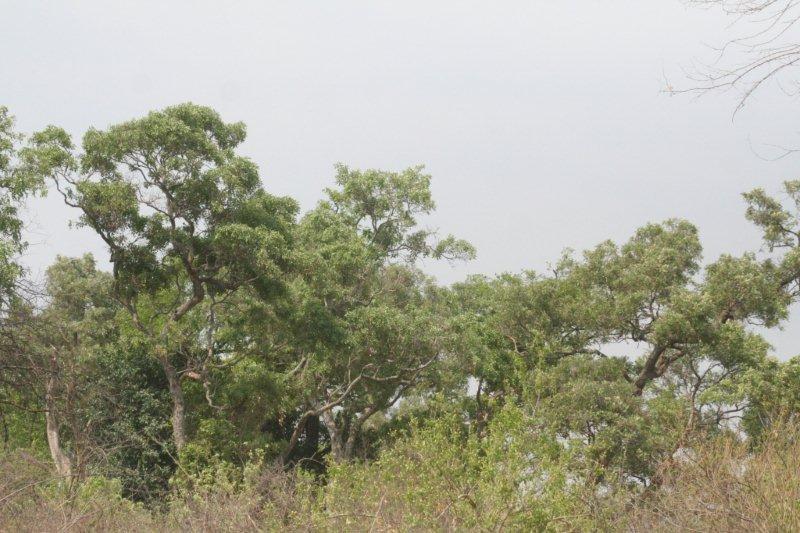

    Meanwhile, back at Sinamatella, the Cicadas are singing, the sun is shining and we are still waiting for the rain. Last year, early rain was followed by weeks of scorching sun. We just hope this year isn’t a repeat of that. 


Thursday, 11 October 2012

Journey to Main Camp

Even though it is only around 100km away, we don’t often get to travel down to Main Camp these days. Last week we were invited to a meeting there to discuss responses to the current poor water supply for animals in the Park. The meeting was due to start early so we had to travel all the way around by the main Victoria Falls to Bulawayo road as the trip through the Park itself is too slow. Sue took the opportunity to get some photos of the communities along the road.
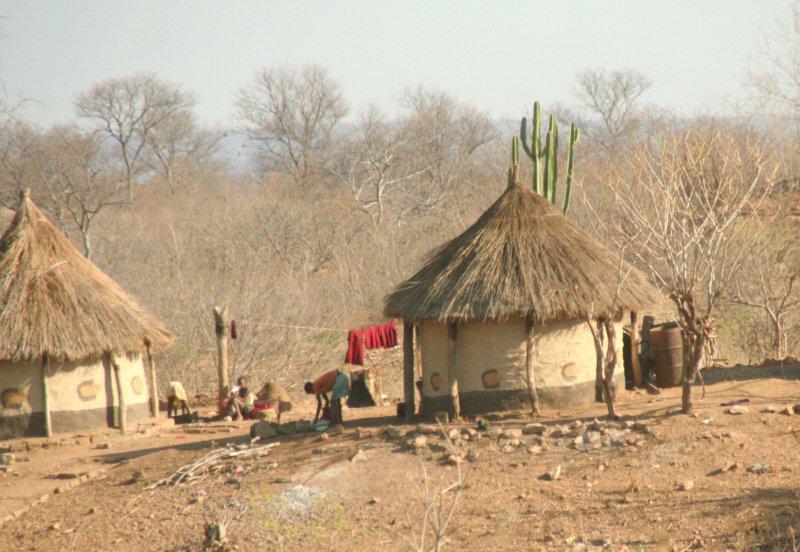
    No two homesteads are alike. Most are traditional round or square huts with earth walls and a grass roof…..


   Not all have a grass roof. This one is made of old oil drums beaten flat……


   Some have a mixture of styles……


   And some are tidy…..


    Whilst others are less so……


To the outsider they are all picturesque but life in these communities can be very hard. Most of the people seen by a passing motorist are women carrying babies, water, food and firewood.


  It is often thought that the men are at home doing nothing while the women do all the work but in many rural communities a lot of the men are away in towns such as Hwange and Bulawayo or are outside the country – in South Africa or Botswana - trying to earn a living.
   Schools are available and most children are willing to walk long distances to attend…..


Though trying to learn in the heat of unshaded classrooms such as these near cross- Dete must be hard.


In such hot, dry countryside, small-scale farming is a precarious way to make a living and some people try other things as well. Along one stretch of the road there are a number of Baobab trees and people here sell the fruits - three for a dollar….


In other seasons the same people sell dried umNyii – the fruits of the wild Bird Plum (Berchemia discolor) or melons that they have grown in their fields.
Nearby are some wood-carvers whose stall has been a feature of this section of the road for many years….


There are two or three small irrigated gardens growing food for sale and home consumption and either using small dams or, as here, a hand-pumped borehole….


And there are various shops, such as Dinde Store, close to the Inyantue River……


 But over long stretches there are still wide open, undeveloped spaces such as here, looking towards Kamativi from around cross-Dete…


Or here, on the road from Dete village……


It was a long hot journey, and it took us to a long hot meeting.  To be honest, I preferred the journey.


Saturday, 29 September 2012

Still searching for 186

  After a lot of searching for our missing rhino, number 186, we still have no certain news of her but we are feeling a little more optimistic.
   Our searches have taken us to all parts of the Sinamatella Intensive Protection Zone. One of the first places we tried was the highest hill in the area, Domboshuro. From the very top of the hill there is a 360 degree view. To the east the Smiths Mine Hills stretch away into the heat haze…..


 And to the north, the bare hills of the Matetsi Safari Area are visible in the far distance……


   At this time of year almost everything is brown. Anything even slightly green is likely to be poisonous or highly unpalatable like this Euphorbia cooperi growing on the slopes of Domboshuro…


    The latex of Euphorbia cooperi is so irritating that it can cause a burning sensation in the throat if you simply stand too close to a damaged plant and breathe in the scent. Nothing, as far as I know, ever eats it.
    In spite of being high above most of the IPZ, we could get no signal for number 186’s transmitter from Domboshuro so we tried elsewhere.
    Much lower down and looking towards Domboshuro in the far distance we tried for signal from a low hill…..


   Nothing.
   We tried from close to Mandavu Dam with the same result…….


We moved away to the east and tried searching along some of the rivers. As on the slopes of Domboshuro, only the unpalatable plants are green here. In this case it is the Woolly Caper Bush Capparis tomentosa that remains green in the otherwise dry and eroded landscape…….


   Woolly Caper Bush seems to be doubly protected. Is leaves and fruits are said to be poisonous and it also has sharp, hooked thorns that scratch and irritate, seeming to stop blood clotting so that a small scratch sometimes  looks like a wound from an attack by a predator. Sue and I call it the Leopard Bush. The one in the picture is growing close to the heavily eroded bank of the Mbala River. Rhino sometimes browse the Leopard Bush but we found no sign of number 186 or any others here.
  On another day we tried to the South. From another of the high hills we could see far into the distance but could get no signal….


   We searched various springs in all parts of the IPZ, such as Tshakabika Hot Spring. A lot of animals had been in the area – the grass cover has gone, replaced by elephant dung……….


 But along the line of the spring itself there is a little grass and good water…..


We saw elephants at the spring but no sign of rhino…..


However, as I said at the start of this, we are feeling a little more optimistic about number 186. One reason is that we got a close look at her son, number 345, sleeping under a Leadwood tree in otherwise open country. There was so little cover it was very hard to approach so the photos were not too great……..


  Through binoculars it was possible to see that his head wound has nearly healed and was almost certainly caused by fighting. It was also possible for the rangers to see the size and condition of the rhino and they are certain that he is big and strong enough to have left his mother to become independent. Usually when rhino first leave their mothers they visit her from time to time and often they are driven away by a male mating with her (hence the head wound?) The best news we had was from a road mending gang in this area who had seen two rhino, one adult and one younger, crossing the road one evening a few weeks ago. We think this must have been 186 and 345 and the time they saw them was long after we lost touch with 186. We are hoping that her transmitter has failed or was damaged, sparring with a male perhaps, and that she is not too far from where 345 was seen. A big search party is planned for next week.


Thursday, 6 September 2012

Searching for number 186

    We have lost one of our rhino. Number 186 who, with her calf, is usually regularly seen by anti-poaching patrols has not been located for several weeks so we have been making some efforts to try to find her.
     Our first thought was that she might simply have moved away from her normal territory. She may have been frightened away by the large number of elephants at her normal watering places or by the  mining exploration that has been taking place in her area (part of which is outside the Park and not protected from the miners). Rather than try to cover a small amount of ground each day on foot we first tried taking a long, slow drive through the places we thought she might have moved to, checking for any signs. We found nothing, though, passing Bumboosie South Pan, we came across this large herd of male elephants drinking from the trough and resting under the trees. Not much chance of a rhino (or anything else) getting a drink there.


   A few days later one of the patrols reported that they had seen a rhino they could not identify and that it had a head wound. We went to investigate. The area where the report came from seemed to be very unlikely country for Black Rhino to be using. The hills are very open and dry……


  Though there are some small river valleys with a bit more cover and I liked this unusually tall Baobab growing from the side of one such valley and in spite of its size, blending in to its bleak background …….


   Dry as the hills are, there are one or two water sources such as this small spring, making a patch of startling green amongst the late winter colours.


I thought the rhino must have been just passing through and didn’t expect us to find any signs of it but one of the Rangers found a spoor……


It isn’t easy to see. Here’s the same picture with the print outlined…..


   Unfortunately that was one of the clearest spoor we saw as we tracked for the next few hours. The ground was mainly stony or covered with Three-awn grass (Aristida rhiniochloa) and we constantly lost the track and had to spread out to search for the next trace. During one of these searches we found not just the spoor but the rhino, sleeping under trees in a small valley. Only Thinkwell saw him properly (the rest of us were not close enough) but he got a very good view indeed, eyeball to eyeball at a distance of about 30 meters. The rhino’s ear tags and the wound on his head were clearly visible. He was number 345, calf of number 186 and we were relieved to hear that the wound looked to have been caused by fighting rather than a poacher’s bullet and didn’t look too serious. The rhino, of course, ran away but in such open country it was easy to see which way he went. We discussed following him but decided it was better to leave him rather than risk scaring him away. After all, we had the information we came for.
  The next question of course is, now that we’ve located number 345, where is his mother? There are several possibilities. She might have chased number 345 away (hence the head wound) and gone off somewhere - perhaps to give birth to another calf. She might just be in the same area and not located, after all the tracking was extremely difficult and her spoor would be hard to see. She might have been killed. We might never know but for now, we continue to search.
    After locating number 345, we returned to Sinamatella, picking up a few of our camera traps on the way. Out of three traps, only one was still attached to a tree as we had left it. The others had been pulled down by elephants but luckily, not damaged. The cameras use an infra-red flash at night, supposedly invisible to the animals but this elephant could certainly see it…


By day the animals, such as these impala, don’t detect the camera so easily…..


But in this unusual photo, an elephant seems to be smelling the camera, which had been pulled down a few days earlier and was lying on its back looking up at the sky.
 

One of the other cameras, monitoring a busy river crossing got pictures of a range of animals.
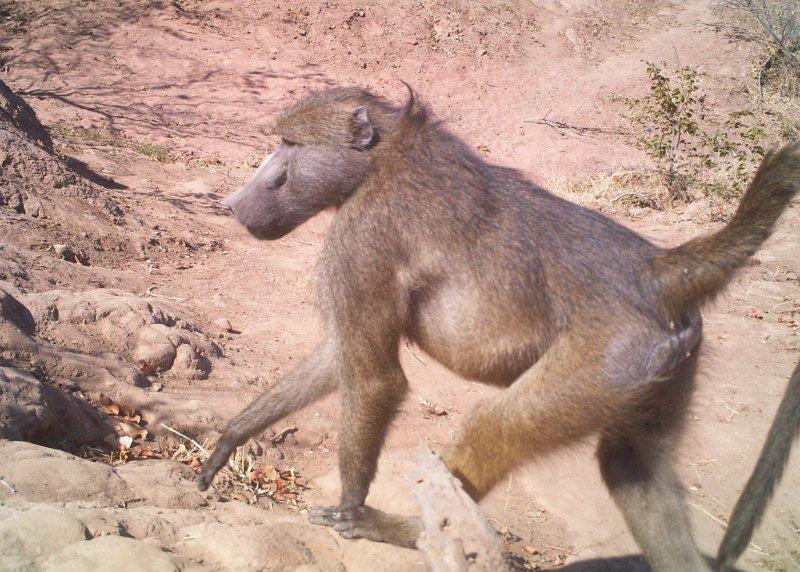
Baboons……


Kudu, including this youngster….


And of course elephants……


   But no rhino. However, one of the other cameras, set nearby did get pictures of a rhino. This is number 251, the dominant male in the area.


And here he shows off the ear notches by which we can recognise him.


He’s not a big animal and not especially old but he has become dominant through the death, either natural or by poachers, of any rivals. We hope he will be around for many years to come.