Thursday, 6 September 2012

Searching for number 186

    We have lost one of our rhino. Number 186 who, with her calf, is usually regularly seen by anti-poaching patrols has not been located for several weeks so we have been making some efforts to try to find her.
     Our first thought was that she might simply have moved away from her normal territory. She may have been frightened away by the large number of elephants at her normal watering places or by the  mining exploration that has been taking place in her area (part of which is outside the Park and not protected from the miners). Rather than try to cover a small amount of ground each day on foot we first tried taking a long, slow drive through the places we thought she might have moved to, checking for any signs. We found nothing, though, passing Bumboosie South Pan, we came across this large herd of male elephants drinking from the trough and resting under the trees. Not much chance of a rhino (or anything else) getting a drink there.


   A few days later one of the patrols reported that they had seen a rhino they could not identify and that it had a head wound. We went to investigate. The area where the report came from seemed to be very unlikely country for Black Rhino to be using. The hills are very open and dry……


  Though there are some small river valleys with a bit more cover and I liked this unusually tall Baobab growing from the side of one such valley and in spite of its size, blending in to its bleak background …….


   Dry as the hills are, there are one or two water sources such as this small spring, making a patch of startling green amongst the late winter colours.


I thought the rhino must have been just passing through and didn’t expect us to find any signs of it but one of the Rangers found a spoor……


It isn’t easy to see. Here’s the same picture with the print outlined…..


   Unfortunately that was one of the clearest spoor we saw as we tracked for the next few hours. The ground was mainly stony or covered with Three-awn grass (Aristida rhiniochloa) and we constantly lost the track and had to spread out to search for the next trace. During one of these searches we found not just the spoor but the rhino, sleeping under trees in a small valley. Only Thinkwell saw him properly (the rest of us were not close enough) but he got a very good view indeed, eyeball to eyeball at a distance of about 30 meters. The rhino’s ear tags and the wound on his head were clearly visible. He was number 345, calf of number 186 and we were relieved to hear that the wound looked to have been caused by fighting rather than a poacher’s bullet and didn’t look too serious. The rhino, of course, ran away but in such open country it was easy to see which way he went. We discussed following him but decided it was better to leave him rather than risk scaring him away. After all, we had the information we came for.
  The next question of course is, now that we’ve located number 345, where is his mother? There are several possibilities. She might have chased number 345 away (hence the head wound) and gone off somewhere - perhaps to give birth to another calf. She might just be in the same area and not located, after all the tracking was extremely difficult and her spoor would be hard to see. She might have been killed. We might never know but for now, we continue to search.
    After locating number 345, we returned to Sinamatella, picking up a few of our camera traps on the way. Out of three traps, only one was still attached to a tree as we had left it. The others had been pulled down by elephants but luckily, not damaged. The cameras use an infra-red flash at night, supposedly invisible to the animals but this elephant could certainly see it…


By day the animals, such as these impala, don’t detect the camera so easily…..


But in this unusual photo, an elephant seems to be smelling the camera, which had been pulled down a few days earlier and was lying on its back looking up at the sky.
 

One of the other cameras, monitoring a busy river crossing got pictures of a range of animals.
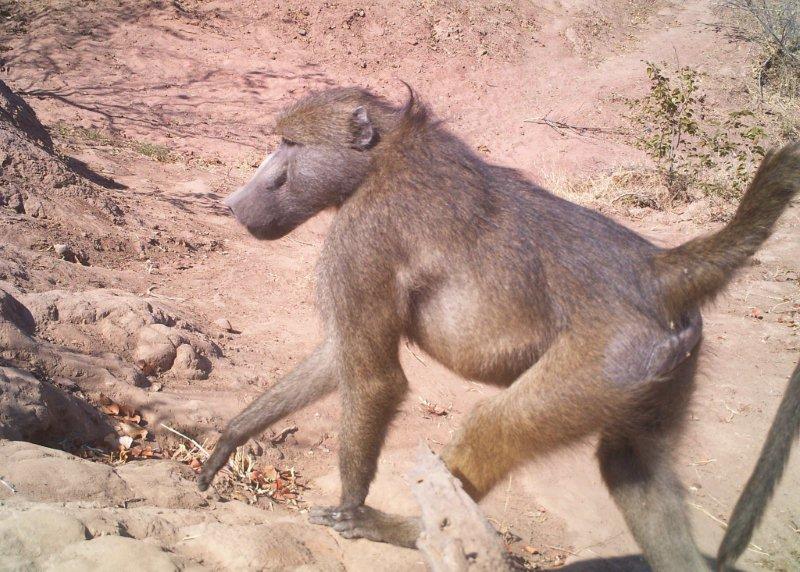
Baboons……


Kudu, including this youngster….


And of course elephants……


   But no rhino. However, one of the other cameras, set nearby did get pictures of a rhino. This is number 251, the dominant male in the area.


And here he shows off the ear notches by which we can recognise him.


He’s not a big animal and not especially old but he has become dominant through the death, either natural or by poachers, of any rivals. We hope he will be around for many years to come.


Wednesday, 15 August 2012

Elephants

  In the rainy season we don’t see many elephants at Sinamatella. Presumably they move out into the Park to feed while there is natural water available to them.

Sinamatella flood plain, December 2011

In the dry season however, elephants, and plenty of them, become a part of every day.
We meet them wherever we drive…..


  And wherever there is water……


..from morning to sunset.


   The adults can be intimidating…….


  but the babies are cute…….


   Elephants are incredibly destructive…….

Baobab tree felled and part eaten by elephants

Water pipe broken by elephants at Shumba

They change the landscape…..

Elephant-damaged Mopane scrub in the foreground, mature Mopane trees behind.

   And they become part of it when they die.


  There are surely far too many………


   But we’d miss them if they were gone.


Volunteer missions 4 and 5

  Since I last posted anything on this blog, we have had two more ‘volunteer missions’ helping us.
   First were Marthe, Cath, Nicolas, Fanny, Sarah and Armelle, pictured here at the edge of Sinamatella hill, close to our house.

 From left to right. Back row, Marthe, Cath and Fanny
                              Front row, Nicolas, Sarah and Armelle.

They helped us with a range of activities including some water pump repairs….

 
Nicolas and myself hauling a pump out of the borehole.

   and our regular water bird count at Mandavu Dam. The water is rapidly receding at Mandavu and there are a lot of animals coming to drink. Just as last year, it is possible to take a photo that would nicely illustrate the word “drought” simply by photographing the animals as they approach the water across the devastated surroundings of the dam. As far as we know there have been no deaths yet but I’m afraid there surely must be some before the rains come.
  
Zebra at Mandavu.

Buffalo leaving after drinking

  The next volunteer group has only just left us to travel to the Main Camp area for a week.

  From left to right, Myself, Laurence, Patricia, Anthony, Sandrine, Marie, Valerie and Sue. 

  The organisation Planete Urgence that sends our volunteers has new security arrangements that do not allow us to walk in the bush so we can no longer track rhino with them. Instead we are involved in a number of animal counting activities. That means we don’t get as close to animals as we used to but we certainly still see plenty of them…..
Lion near Kashawe view point.

Hippo, Mandavu Dam

Impala and male Kudu at Masuma

Dassie.

   Every year the dassies at Sinamatella become more and more tame as the dry season progresses and food becomes scarce. Those living near our house are used to receiving vegetable scraps from the kitchen (no point in throwing them in the dustbin for the Hyenas, Baboons and Honey Badgers to take them out again) and inevitably a few of them become tame enough to come running as soon as they see Sue approaching with some old lettuce or cabbage leaves. We try not to give them so much that they become dependant on us but they are not easy to resist!


Saturday, 21 July 2012

Game water

In the dry season, Hwange is largely dependent on artificial water sources. Here in Sinamatella we are lucky in that there are a number of reliable springs in the Park and the neighbouring Deka Safari Area. Close to the camp we have the large Tshakabika Hot Spring, the Salt Springs complex, the two Domboshuro Springs and the Kashawe Springs. In the Safari Area are Big and Little Gobo Springs, Big and Little Mambane and Chawato Sulphur Spring and near Bumboosie Camp there are a number of excellent Springs. We also have good water in the Sinamatella River but all of these places are in the northern sector. To the South of Sinamatella, approaching the Kalahari Sand country, water is scarce. Mandavu Dam is the most reliable and is filled each year by rain water. Mandavu, Shumba, Tshompani and Inyantue all rely on water pumped from underground.
  Last week we took a newly donated pump engine and two attendants out to Inyantue to start pumping for the season. Inyantue is the furthest pump from Sinamatella, about 80km, taking several hours. Our first stop was at Masuma where the attendants had reported the engine would not run. Mr Mafa, who has years of enormously valuable experience, soon spotted the problem, fixed it and got the water running again.
  We moved on to Shumba. A dead elephant, killed in a fight, was a fitting foreground to the very bleak-looking pan.
Shumba Pan

There is one hippo remaining in the pan, but he doesn’t look too cheerful – barely visible in the mud.

We found the wind pump and diesel pump both running and went on to Tshompani Dam.
Tshompani never holds water for long, even in the rains so it is supplied by a diesel-powered pump and a wind pump. The wind pump is currently out of action awaiting repair but the diesel is working and there is a reasonable pool of water in the lowest part of the dam.

Tshompani seen from the dam wall.

The final stop was at Inyantue where the dam was totally dry.


We had brought with us a new engine and Mr Mafa and his team soon had it fitted and running.
Carrying the engine to the borehole.

Engine installed and running. Mr Mafa cleans away a speck or two of dust!

Sue accompanied us on this trip as official photographer and, of course, provider of tea.


My job was less easy to define. Observer perhaps…..


Within ten minutes of the pump starting we found baboons drinking at the trough as it started to fill but they ran away as soon as they saw us – returning, no doubt, within minutes of us leaving.


We left two pump attendants to look after this, Sinamatella’s most remote outpost and were a kilometre or so away when Mr Mafa stopped us. Once before he had left pump attendants far from anywhere only to discover much later that they had no matches, hence no fire and no way to cook. He was concerned about the two attendants we had left at Inyantue. They are not experienced; maybe they would have no matches. We went back and indeed, they had forgotten so we rummaged around and found some matches for them and drove away again. I’ve since heard via the radio that they and the pump are doing well!


Sunday, 8 July 2012

24 - hour game count

In my last post I said maybe I would have some decent rhino photos this time. Well I haven’t - but we came close to getting some of the most spectacular ever.
   We have just been working with our third group of volunteers for the year and on one day we were tracking rhino number 299. She is a young female who has a habit of sleeping under very low bushes or behind fallen trees where she can be extremely hard to see. She is fitted with a radio transmitter but it is not working properly and sometimes doesn’t work at all. Walking through some fairly open woodland, we disturbed number 299 without even knowing we were close to her and she got up from behind a fallen tree and ran away. Unfortunately in her panic she ran through the group of rangers and volunteers. Everyone took cover but volunteer Sebastien Pladys fell over with the rhino running parallel to him and she ran to him and stood over him as he lay on his back looking up at her. She pushed him, gently by her standards but hard by our standards then went away. Sebastien says she kissed him and indeed he had a small cut on his lip but unfortunately he was too preoccupied to take photos! Luckily Sebastien was unhurt apart from some minor bruises.
   No photo of the rhino then, but here is Sebastien, a few days later resting after a night counting animals on a 24 hour animal count.


The other volunteers on this mission were Cherif and Marie who were also with us on the last mission and Nadège Maunoury……

Nadège

  Apert from rhino tracking, one of the activities on this mission was the 24 hour animal count at Masuma Dam. We started counting at midday on 29 June and finished at midday on the 30th. This count has been carried out many times over many years and we thought we knew what to expect but we were completely wrong. A summary of results is included at the end of this post but the key result is the number of elephants. In previous years June counts have revealed a maximum of around three hundred elephants in 24 hours but on this occasion we counted the extraordinary number of 1195. To put that in perspective, that’s more than is ever counted at the end of the dry season when the dam gets ‘busy’ in a normal year and slightly higher even than some October counts in dry years.

Elephants approaching Masuma. 12.05pm 29 June 2012.

This high number of elephants is presumably a sign that the natural water deep in the Park, where they would normally be at this time of year, has already dried up. It is going to be almost impossible to supply enough water to these animals – if they drink 30 litres each on average (and that’s almost certainly a very conservative estimate) then the elephants alone are taking over 30,000 litres of water per day from the dam. Add to that all the other animals, seepage and evaporation and even with the pump running 24 hours a day (as it is) there’s just not enough water.
   On the plus side it does make for some excellent game viewing..

Buffalo approaching…….

And drinking, with hippo fighting in the foreground.

The obligatory Masuma photograph – sunset with elephants.

So, here’s a very brief summary of our game count results…..

Masuma Dam Game Count, 29 to 30 June 2012.              
Elephant:     1195
Buffalo:       282
Impala:        253
Kudu:          100
Waterbuck:  55
Baboon:       40
Zebra:          34
Warthog:     25
Spotted hyena: 6
Black-backed Jackal: 1
Giraffe:       1


Saturday, 7 July 2012

Second Planete-Urgence volunteers

The second Planete Urgence volunteer mission of the year has recently been with us. There were just three volunteers – Marie, Cherif and Sylvie.


Cherif, Marie, Sue and myself, Stewart, Sylvie and Thinkwell

  On the first day of their visit we did a road transect count. The weather was unusually cold but we still saw quite a few animals including this nice group of giraffe….


   At Baobab Pan we found that the elephants had broken the connection to the pump again and the trough and pan were both dry…………


 …..apart from a patch of mud in the middle of the pan.


     When we got back to Sinamatella we reported the problem and next day we accompanied Mr Mafa and some of his team to make some repairs.
      Cherif and I disconnected the solar panels to stop the pump……


  And it was only after we’d done it that we discovered a tiny on/off switch hidden away on the back of the inverter.
   We fitted some new pipes….


………bolted the pump more firmly to the well-head…….


   And when we switched back on again the water started to flow back into the trough.


This White-browed Sparrow Weaver was so thirsty it came to the water straight away as we were standing there……


    We spent four days with the volunteers looking for rhino. On the first day we got a sighting of one of the males but he was in thick cover so no-one got a good photo. The second day was frustrating. We got very close to one of the animals with a radio-implant but couldn’t see her then, as we tried to get closer, the transmitter stopped working and we were unable to find her. She was sleeping somewhere on hard ground and had left no spoor so we avoided disturbing her and returned to camp. On the third day we tried for the same rhino again but drew a complete blank though we ranged some distance outside the Park into the Hwange Colliery Concession where we found this abandoned building…..


I think it is almost certainly Doctor Evil’s secret African hideout – though it could simply be an abandoned ventilator for the closed number two mine of course…...
On our last day we located and monitored rhino number 186. She was very hard to see, sleeping in long grass but Thinkwell, then Sylvie climbed a nearby tree and got a decent view when the rhino woke up and moved to a deeper patch of shade.


 Neither of them got a good photo so I’m still looking for a decent rhino photo to post. Maybe next time.